桧 (guì) means "Chinese juniper" in Chinese. It has 10 strokes with the radical 木.
Rated 4.2/5 in difficulty (advanced).
Appears in 3+ common words including 桧树 (guì shù), 桧木 (guì mù), 秦桧 (qín guì).
Due to its 10 strokes, Hanzi Writer's error detection shows 桧 requires focused practice — most learners need 10+ attempts for consistent accuracy.
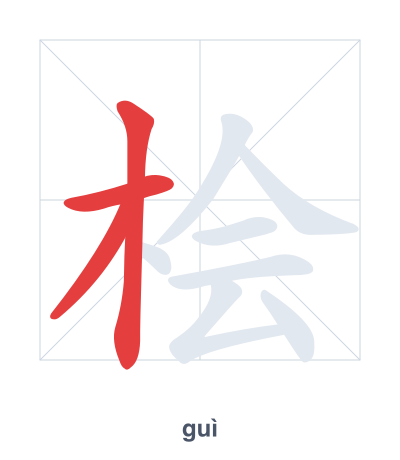
Open Hanzi Writer to see the animated stroke order and practice writing 桧 with real-time feedback.
The character 桧 (guì) is written with 10 strokes. Follow the standard Chinese stroke order: top to bottom, left to right, outside before inside. The radical 木 is one of its key components.
Practice the correct stroke order with the Hanzi Writer app to see animated stroke-by-stroke guidance with real-time feedback.
桧 means Chinese juniper.
桧 is a phono-semantic compound combining the tree radical 木 (wood) with 会 (huì), which provides the pronunciation. The character denotes the Chinese juniper, an evergreen conifer often used in traditional landscaping and known for its fragrant wood.
💡 Memory Tip: Imagine a juniper tree (木) where a clandestine meeting (会) of forest spirits takes place under its dense, aromatic branches.
桧树四季常青。
guì shù sì jì cháng qīng
Chinese junipers are evergreen all year round.
桧木有淡淡香味。
guì mù yǒu dàn dàn xiāng wèi
Cypress wood has a faint fragrance.
秦桧是历史人物。
qín guì shì lì shǐ rén wù
Qin Hui is a historical figure.
Open Hanzi Writer to see the animated stroke order and practice writing 桧 with real-time feedback.
✨ Animated stroke order · Handwriting recognition · HSK-graded practice · Free to use
The character 桧 is made of the radical 木 (tree) on the left, showing it is a type of tree. The right side is 会 (huì), which mainly gives a hint about pronunciation, though the actual pinyin is guì. Together, 木 and 会 form the character for Chinese juniper.