秦 (qín) means "Qin (dynasty or surname)" in Chinese. It has 10 strokes with the radical 禾.
Rated 4.2/5 in difficulty (advanced).
Appears in 3+ common words including 秦朝 (qín cháo), 秦腔 (qín qiāng), 秦岭 (qín lǐng).
Due to its 10 strokes, Hanzi Writer's error detection shows 秦 requires focused practice — most learners need 10+ attempts for consistent accuracy.
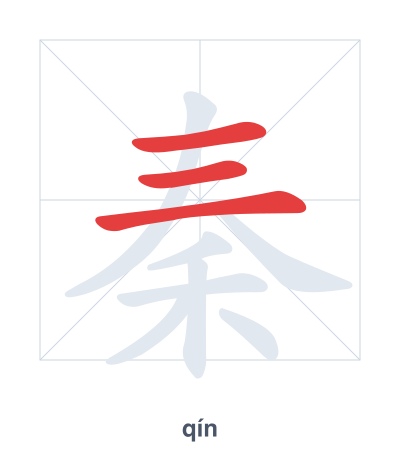
Open Hanzi Writer to see the animated stroke order and practice writing 秦 with real-time feedback.
The character 秦 (qín) is written with 10 strokes. Follow the standard Chinese stroke order: top to bottom, left to right, outside before inside. The radical 禾 is one of its key components.
Practice the correct stroke order with the Hanzi Writer app to see animated stroke-by-stroke guidance with real-time feedback.
秦 means Qin (dynasty or surname).
秦 combines 禾 (grain) above with 舛 (two feet stepping) below, originally depicting a person threshing grain by foot—a key activity in the fertile lands of the ancient Qin state. Over time, it became the name of the powerful Qin dynasty and a common surname.
💡 Memory Tip: Imagine two feet (舛) stomping on a pile of grain (禾) to thresh it, while a Qin emperor watches—that's how the Qin got their agricultural strength.
秦朝是中国第一个朝代。
qín cháo shì zhōng guó dì yí gè cháo dài
The Qin Dynasty was the first dynasty of China.
他喜欢听秦腔。
tā xǐ huān tīng qín qiāng
He likes listening to Qinqiang opera.
秦岭在西安南边。
qín lǐng zài xī ān nán biān
The Qinling Mountains are to the south of Xi'an.
Open Hanzi Writer to see the animated stroke order and practice writing 秦 with real-time feedback.
✨ Animated stroke order · Handwriting recognition · HSK-graded practice · Free to use
秦 is composed of three parts: the top (㐄, a variation of 禾 meaning "grain"), middle (𠂉, a hand), and bottom (水, water). Together, they suggest "people harvesting grain near water," which relates to the ancient state of Qin, an agricultural region. However, the modern meaning of Qin as a dynasty or surname does not directly come from this image.