勾 (gōu/gòu) means "to tick or hook" in Chinese. It has 4 strokes with the radical 勹, and is HSK Level 7.
Rated 2.4/5 in difficulty (moderate).
Harder than 2% of HSK Level 7 characters.
Appears in 3+ common words including 勾画 (gōu huà), 勾结 (gōu jié), 勾当 (gòu dàng).
Hanzi Writer's stroke validation shows learners typically need 5-8 attempts to write 勾 with correct proportion and order.
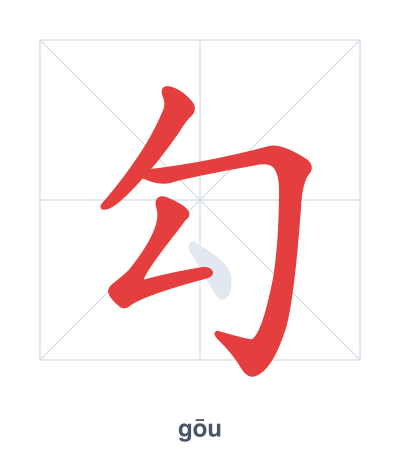
Open Hanzi Writer to see the animated stroke order and practice writing 勾 with real-time feedback.
The character 勾 (gōu/gòu) is written with 4 strokes. Follow the standard Chinese stroke order: top to bottom, left to right, outside before inside. The radical 勹 is one of its key components.
Practice the correct stroke order with the Hanzi Writer app to see animated stroke-by-stroke guidance with real-time feedback.
勾 means to tick or hook.
This is a polyphonic character with readings: gōu, gòu.
As an HSK Level 7 character, 勾 is an intermediate-level character.
The character 勾 originated as a pictograph of a curved hook or bent line. Its radical 勹 (wrap) depicts the bending shape, while the component 厶 (private) may have been added later to represent a small hooked end or to aid pronunciation. Together, they form the visual idea of something that hooks or catches.
💡 Memory Tip: Picture the top curved stroke as a hook bending down, and the bottom triangle (厶) as the barb that snags onto things.
画家几笔就勾画出了一幅生动的素描作品。
huà jiā jǐ bǐ jiù gōu huà chū le yī fú shēng dòng de sù miáo zuò pǐn
With a few strokes, the painter sketched a vivid drawing.
这种官商勾结的行为严重破坏了市场秩序。
zhè zhǒng guān shāng gōu jié de xíng wéi yán zhòng pò huài le shì chǎng zhì xù
This collusion between government and business seriously undermines market order.
这两个家伙在暗中干着见不得人的勾当。
zhè liǎng gè jiā huo zài àn zhōng gàn zhe jiàn bù dé rén de gòu dàng
These two guys are secretly engaged in shady business.
Open Hanzi Writer to see the animated stroke order and practice writing 勾 with real-time feedback.
✨ Animated stroke order · Handwriting recognition · HSK-graded practice · Free to use
勾 combines the radical 勹 (a wrapping or enclosing motion) with the phonetic component 厶 (sī, private). The 勹 suggests a hooking or bending action, and together they form the idea of something that hooks or ticks.