栱 (gǒng) means "Bracket or corbel in traditional architecture" in Chinese. It has 10 strokes with the radical 木.
Rated 4.2/5 in difficulty (advanced).
Appears in 3+ common words including 斗栱 (dòu gǒng), 栱子 (gǒng zi), 柱栱 (zhù gǒng).
Due to its 10 strokes, Hanzi Writer's error detection shows 栱 requires focused practice — most learners need 10+ attempts for consistent accuracy.
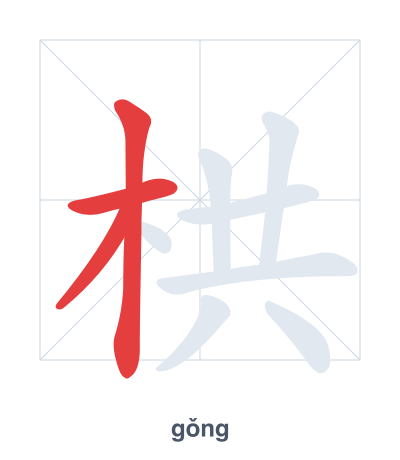
Open Hanzi Writer to see the animated stroke order and practice writing 栱 with real-time feedback.
The character 栱 (gǒng) is written with 10 strokes. Follow the standard Chinese stroke order: top to bottom, left to right, outside before inside. The radical 木 is one of its key components.
Practice the correct stroke order with the Hanzi Writer app to see animated stroke-by-stroke guidance with real-time feedback.
栱 means Bracket or corbel in traditional architecture.
栱 is a compound character with the radical 木 (wood/tree) indicating it relates to timber, and the phonetic component 共 (gòng, meaning 'together' or 'shared'). The original meaning is a wooden bracket that works together with other beams to support a roof, so the character visually combines 'wood' with the idea of 'working together.'
💡 Memory Tip: Picture a sturdy wooden (木) beam with two arms raised together (共)—like a friendly builder helping hold up the temple roof.
中国古建筑有斗栱。
zhōng guó gǔ jiàn zhù yǒu dòu gǒng
Ancient Chinese architecture features bracket sets (dougong).
这里的栱子很精美。
zhè lǐ de gǒng zi hěn jīng měi
The brackets here are very exquisite.
柱栱支撑着屋顶。
zhù gǒng zhī chēng zhe wū dǐng
The brackets support the roof.
Open Hanzi Writer to see the animated stroke order and practice writing 栱 with real-time feedback.
✨ Animated stroke order · Handwriting recognition · HSK-graded practice · Free to use
栱 is made of two parts: the left side 木 (wood) and the right side 共 (gǒng, meaning together or shared). The wood radical shows the material, and 共 suggests that the bracket holds beams together. So 栱 literally means a wooden piece that joins other parts in traditional buildings.