仡 (gē) means "strong; brave" in Chinese. It has 5 strokes with the radical 亻.
Rated 2.7/5 in difficulty (moderate).
Appears in 3+ common words including 仡佬族 (gē lǎo zú), 仡勇 (gē yǒng), 仡仡 (gē gē).
Hanzi Writer's stroke validation shows learners typically need 5-8 attempts to write 仡 with correct proportion and order.
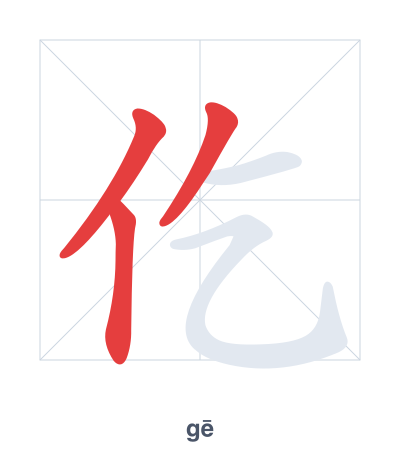
Open Hanzi Writer to see the animated stroke order and practice writing 仡 with real-time feedback.
The character 仡 (gē) is written with 5 strokes. Follow the standard Chinese stroke order: top to bottom, left to right, outside before inside. The radical 亻 is one of its key components.
Practice the correct stroke order with the Hanzi Writer app to see animated stroke-by-stroke guidance with real-time feedback.
仡 means strong; brave.
仡 is a compound character built from the radical 亻 (person) and the phonetic component 乞 (gē). The original meaning depicted a person standing tall and imposing, conveying strength and bravery.
💡 Memory Tip: Picture a strong person (亻) lifting a bent barbell shaped like 乞, showing off their brave muscles.
他是仡佬族人。
tā shì gē lǎo zú rén
He is of the Gelao ethnic group.
战士们表现得很仡勇。
zhàn shì men biǎo xiàn dé hěn gē yǒng
The soldiers showed great bravery.
他的样子看起来很仡仡。
tā de yàng zi kàn qǐ lái hěn gē gē
He looks very strong and upright.
Open Hanzi Writer to see the animated stroke order and practice writing 仡 with real-time feedback.
✨ Animated stroke order · Handwriting recognition · HSK-graded practice · Free to use
仡 is made of two parts: the radical 亻 (person) on the left and 乞 (gē, meaning "beg") on the right. The radical shows that the character relates to a person, and the right side gives the pronunciation. Together they represent a person who is strong and brave, though the meaning does not come from the literal parts.