鳆 (fù) means "abalone" in Chinese. It has 17 strokes with the radical 鱼.
Rated 4.2/5 in difficulty (advanced).
Appears in 3+ common words including 鳆鱼 (fù yú), 鳆鱼汤 (fù yú tāng), 鲜鳆 (xiān fù).
Due to its 17 strokes, Hanzi Writer's error detection shows 鳆 requires focused practice — most learners need 10+ attempts for consistent accuracy.
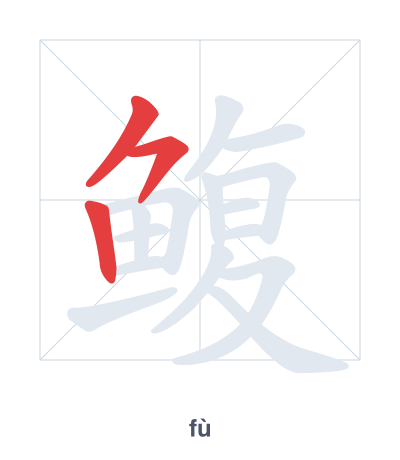
Open Hanzi Writer to see the animated stroke order and practice writing 鳆 with real-time feedback.
The character 鳆 (fù) is written with 17 strokes. Follow the standard Chinese stroke order: top to bottom, left to right, outside before inside. The radical 鱼 is one of its key components.
Practice the correct stroke order with the Hanzi Writer app to see animated stroke-by-stroke guidance with real-time feedback.
鳆 means abalone.
鳆 is a phono-semantic compound: the radical 鱼 (fish) signifies it is a marine creature, while 复 (fù, meaning 'again' or 'to repeat') serves as a phonetic component indicating the pronunciation fù. The character specifically refers to abalone, a type of shellfish, not actually a fish, but grouped under the 'fish' radical due to its aquatic nature.
💡 Memory Tip: Imagine a fish (鱼) wearing a fancy abalone shell with a 'repeat' button (复) on it, because you keep coming back for more of this delicious seafood.
鳆鱼是一种海鲜。
fù yú shì yī zhǒng hǎi xiān
Abalone is a type of seafood.
鳆鱼汤很好喝。
fù yú tāng hěn hǎo hē
Abalone soup is delicious.
这里的鲜鳆很贵。
zhè lǐ de xiān fù hěn guì
The fresh abalone here is very expensive.
Open Hanzi Writer to see the animated stroke order and practice writing 鳆 with real-time feedback.
✨ Animated stroke order · Handwriting recognition · HSK-graded practice · Free to use
鳆 is made of the radical 鱼 (fish) on the left and the component 复 on the right. The 鱼 radical indicates that the character relates to a sea creature, and 复 gives the sound 'fù'. Together they form the word for abalone, which is a type of shellfish.