怫 (fú) means "angry; indignant" in Chinese. It has 8 strokes with the radical 忄.
Rated 3.7/5 in difficulty (challenging).
Appears in 3+ common words including 怫然 (fú rán), 怫郁 (fú yù), 忧怫 (yōu fú).
Due to its 8 strokes, Hanzi Writer's error detection shows 怫 requires focused practice — most learners need 10+ attempts for consistent accuracy.
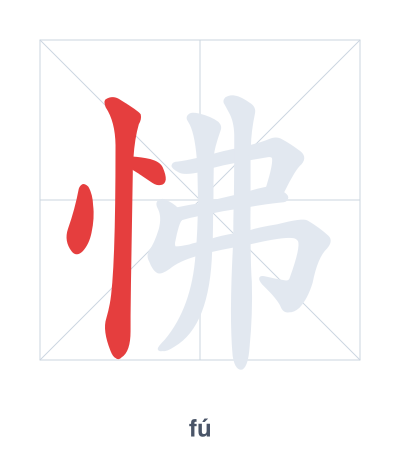
Open Hanzi Writer to see the animated stroke order and practice writing 怫 with real-time feedback.
The character 怫 (fú) is written with 8 strokes. Follow the standard Chinese stroke order: top to bottom, left to right, outside before inside. The radical 忄 is one of its key components.
Practice the correct stroke order with the Hanzi Writer app to see animated stroke-by-stroke guidance with real-time feedback.
怫 means angry; indignant.
怫 is a compound character. The left-side radical 忄 (heart) indicates emotion, while the right-side component 弗 (fú) provides the sound. Together, they express a feeling of anger rising in the heart, as if something is twisted or obstructed.
💡 Memory Tip: Picture your heart (忄) getting tied in a knot by a twisted bow (弗), making you angry.
他怫然离去。
tā fú rán lí qù
He left in a huff.
他心中怫郁。
tā xīn zhōng fú yù
He felt depressed and frustrated.
别再忧怫了。
bié zài yōu fú le
Stop being depressed.
Open Hanzi Writer to see the animated stroke order and practice writing 怫 with real-time feedback.
✨ Animated stroke order · Handwriting recognition · HSK-graded practice · Free to use
怫 is made of the heart radical 忄 on the left and the phonetic component 弗 on the right. The radical 忄 indicates an emotion or mental state, so the character means 'angry' or 'indignant.' The right side 弗 provides the pronunciation fú but does not directly contribute to the meaning.