吠 (fèi) means "to bark" in Chinese. It has 7 strokes with the radical 口.
Rated 3.5/5 in difficulty (challenging).
Appears in 3+ common words including 吠叫 (fèi jiào), 狂吠 (kuáng fèi), 吠声 (fèi shēng).
Due to its 7 strokes, Hanzi Writer's error detection shows 吠 requires focused practice — most learners need 10+ attempts for consistent accuracy.
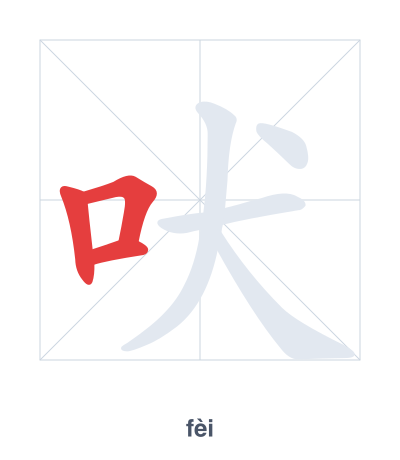
Open Hanzi Writer to see the animated stroke order and practice writing 吠 with real-time feedback.
The character 吠 (fèi) is written with 7 strokes. Follow the standard Chinese stroke order: top to bottom, left to right, outside before inside. The radical 口 is one of its key components.
Practice the correct stroke order with the Hanzi Writer app to see animated stroke-by-stroke guidance with real-time feedback.
吠 means to bark.
吠 is a compound character combining 口 (mouth) and 犬 (dog), literally meaning 'the mouth of a dog'. This vividly depicts the action of a dog barking, as the mouth is the source of the sound.
💡 Memory Tip: Imagine a dog (犬) opening its mouth (口) wide to let out a loud 'woof!'
狗在外面吠叫。
gǒu zài wài miàn fèi jiào
The dog is barking outside.
邻居的狗在狂吠。
lín jū de gǒu zài kuáng fèi
The neighbor's dog is barking wildly.
我听到了狗吠声。
wǒ tīng dào le gǒu fèi shēng
I heard a dog barking.
Open Hanzi Writer to see the animated stroke order and practice writing 吠 with real-time feedback.
✨ Animated stroke order · Handwriting recognition · HSK-graded practice · Free to use
The character 吠 is composed of the radical 口 (mouth) on the left and 犬 (dog) on the right. Together, they literally mean "a dog's mouth" — the action of a dog using its mouth to bark.