Hanzi Writer

How to Write 扉 (fēi) — Meaning “door leaf / title page”

fēi 12 strokes Radical: 户

扉 (fēi) means "door leaf / title page" in Chinese. It has 12 strokes with the radical 户.

Rated 4.2/5 in difficulty (advanced).

Appears in 3+ common words including 心扉 (xīn fēi), 扉页 (fēi yè), 门扉 (mén fēi).

Due to its 12 strokes, Hanzi Writer's error detection shows 扉 requires focused practice — most learners need 10+ attempts for consistent accuracy.
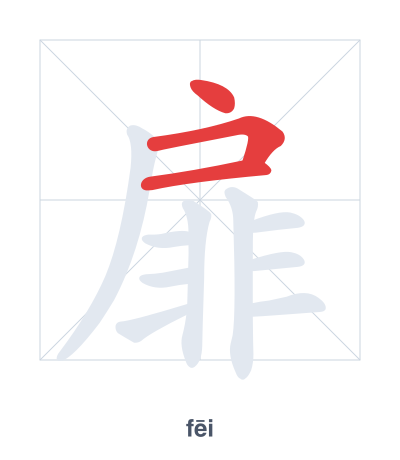
Stroke order practice for 扉 - fēi

Practice Writing 扉 (fēi)

Open Hanzi Writer to see the animated stroke order and practice writing 扉 with real-time feedback.

The character (fēi) is written with 12 strokes. Follow the standard Chinese stroke order: top to bottom, left to right, outside before inside. The radical is one of its key components.

Practice the correct stroke order with the Hanzi Writer app to see animated stroke-by-stroke guidance with real-time feedback.

means door leaf / title page.

Character
Pinyinfēi (fei)
Meaningdoor leaf / title page
Strokes12
Radical
Difficulty4.2/5

This character combines the radical 户 (door) with the phonetic component 非 (fēi). The door radical indicates it relates to a door, specifically a door leaf or panel, and the phonetic gives the sound.

💡 Memory Tip: Imagine a door (户) with two swinging panels shaped like the character 非, which open to reveal the title page of a book.

xīn fēi
the door to one's heart
fēi yè
title page (of a book)
mén fēi
Door leaf / Door

音乐打开了心扉。

yīn yuè dǎ kāi le xīn fēi

Music opened the heart.

我在扉页上写了名字。

wǒ zài fēi yè shàng xiě le míng zì

I wrote my name on the title page.

他轻轻推开了门扉。

tā qīng qīng tuī kāi le mén fēi

He gently pushed open the door.

Character Pinyin Strokes Radical
(current) fēi 12
10
shān / shàn 10
11
Stroke order practice for 扉 - fēi

Practice Writing 扉 (fēi)

Open Hanzi Writer to see the animated stroke order and practice writing 扉 with real-time feedback.

✨ Animated stroke order · Handwriting recognition · HSK-graded practice · Free to use

Frequently Asked Questions about 扉

扉 combines the radical 户 (door) with the component 非, which originally meant 'to oppose' but here visually suggests two door leaves. Together, they form the idea of a door leaf or the panel of a door, emphasizing both the door frame and the two halves.

Characters with Radical 户

Other 12-Stroke Characters