樊 (fán) means "Cage / fence" in Chinese. It has 15 strokes with the radical 木.
Rated 3.9/5 in difficulty (challenging).
Appears in 3+ common words including 姓樊 (xìng fán), 樊篱 (fán lí), 樊笼 (fán lóng).
Due to its 15 strokes, Hanzi Writer's error detection shows 樊 requires focused practice — most learners need 10+ attempts for consistent accuracy.
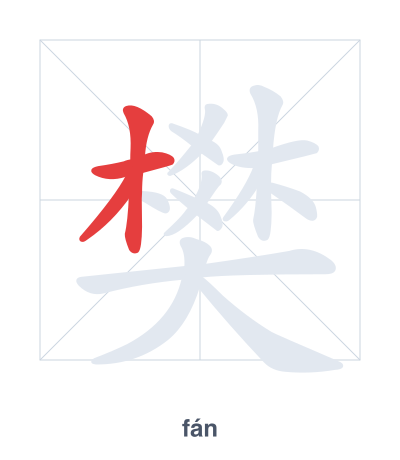
Open Hanzi Writer to see the animated stroke order and practice writing 樊 with real-time feedback.
The character 樊 (fán) is written with 15 strokes. Follow the standard Chinese stroke order: top to bottom, left to right, outside before inside. The radical 木 is one of its key components.
Practice the correct stroke order with the Hanzi Writer app to see animated stroke-by-stroke guidance with real-time feedback.
樊 means Cage / fence.
樊 combines 林 (forest, trees) above and a lower part of 大 (person) with two crossed strokes (乂乂), representing interwoven branches forming a fence or cage. Its ancient form depicted a pen made of wooden bars enclosing an animal or person.
💡 Memory Tip: Imagine a forest (林) where a big person (大) is trapped inside a cage made of crossed wooden bars (乂乂), creating a fence.
我的老师姓樊。
wǒ de lǎo shī xìng fán
My teacher's surname is Fan.
冲破传统的樊篱。
chōng pò chuán tǒng de fán lí
Break through the barriers of tradition.
鸟儿飞出了樊笼。
niǎo ér fēi chū le fán lóng
The bird flew out of the cage.
Open Hanzi Writer to see the animated stroke order and practice writing 樊 with real-time feedback.
✨ Animated stroke order · Handwriting recognition · HSK-graded practice · Free to use
樊 is composed of two 木 (tree/wood) radicals at the top and bottom, with a 爻 (lines/cross) in between and 大 (big) at the bottom. The two 木 suggest a wooden enclosure, and the 爻 represents crossed bars, which together form a cage or fence. The 大 at the bottom may indicate something large held within, reinforcing the idea of confinement.