棥 (fán) means "fence; hedge" in Chinese. It has 12 strokes with the radical 木.
Rated 4.2/5 in difficulty (advanced).
Appears in 3+ common words including 棥篱 (fán lí), 棥栅 (fán zhà), 棥落 (fán luò).
Due to its 12 strokes, Hanzi Writer's error detection shows 棥 requires focused practice — most learners need 10+ attempts for consistent accuracy.
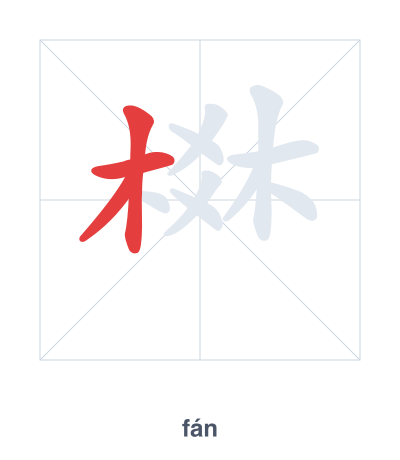
Open Hanzi Writer to see the animated stroke order and practice writing 棥 with real-time feedback.
The character 棥 (fán) is written with 12 strokes. Follow the standard Chinese stroke order: top to bottom, left to right, outside before inside. The radical 木 is one of its key components.
Practice the correct stroke order with the Hanzi Writer app to see animated stroke-by-stroke guidance with real-time feedback.
棥 means fence; hedge.
棥 combines 木 (tree) and 林 (forest), depicting a barrier or hedge made from multiple trees or wooden stakes. The three trees symbolize a dense, protective enclosure.
💡 Memory Tip: Visualize three trees (木+林) standing side by side like a row of fence posts forming a living hedge.
屋后有一道木制的棥篱。
wū hòu yǒu yī dào mù zhì de fán lí
There is a wooden fence behind the house.
花园被棥栅围了起来。
huā yuán bèi fán zhà wéi le qǐ lái
The garden is enclosed by a fence.
古人常在院外修筑棥落。
gǔ rén cháng zài yuàn wài xiū zhù fán luò
Ancient people often built fences outside their courtyards.
Open Hanzi Writer to see the animated stroke order and practice writing 棥 with real-time feedback.
✨ Animated stroke order · Handwriting recognition · HSK-graded practice · Free to use
棥 is composed of the radical 木 (wood) on the left and the component 樊 on the right. The left side 木 indicates that the meaning relates to wood, while the right side 樊 suggests an enclosure or barrier, together forming the idea of a fence or hedge made of wood.