佴 (èr) means "Er (a surname)" in Chinese. It has 8 strokes with the radical 亻.
Rated 3.4/5 in difficulty (challenging).
Appears in 3+ common words including 佴姓 (èr xìng), 佴氏 (èr shì), 佴家 (èr jiā).
Due to its 8 strokes, Hanzi Writer's error detection shows 佴 requires focused practice — most learners need 10+ attempts for consistent accuracy.
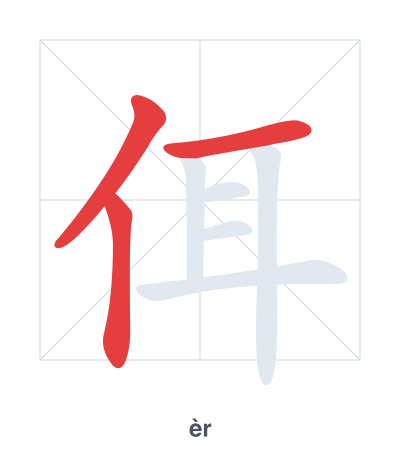
Open Hanzi Writer to see the animated stroke order and practice writing 佴 with real-time feedback.
The character 佴 (èr) is written with 8 strokes. Follow the standard Chinese stroke order: top to bottom, left to right, outside before inside. The radical 亻 is one of its key components.
Practice the correct stroke order with the Hanzi Writer app to see animated stroke-by-stroke guidance with real-time feedback.
佴 means Er (a surname).
佴 is a compound character with the radical 亻 (person) and the phonetic component 耳 (ear). It is primarily used as a surname, and the ear element likely provides the pronunciation hint rather than contributing to the literal meaning.
💡 Memory Tip: Imagine a person (亻) with an oversized ear (耳) who can hear you from across a room—that's Mr. Er, with a name that sounds like 'ear'.
佴姓是一个稀有姓氏。
èr xìng shì yí gè xī yǒu xìng shì
The surname Er is a rare surname.
他是佴氏家族的成员。
tā shì èr shì jiā zú de chéng yuán
He is a member of the Er family.
佴家住在那个村子。
èr jiā zhù zài nà ge cūn zi
The Er family lives in that village.
Open Hanzi Writer to see the animated stroke order and practice writing 佴 with real-time feedback.
✨ Animated stroke order · Handwriting recognition · HSK-graded practice · Free to use
The character 佴 is made of the radical 亻 (person) on the left and 耳 (ear) on the right. The person radical indicates that it relates to a person, but 耳 here mainly acts as a phonetic component, giving the pronunciation "èr". This structure is common for Chinese surnames, where the phonetic part helps remember the sound.