洱 (ěr) means "Er (used in Erhai Lake)" in Chinese. It has 9 strokes with the radical 氵.
Rated 4/5 in difficulty (challenging).
Appears in 3+ common words including 普洱茶 (pǔ ěr chá), 洱海 (ěr hǎi), 普洱 (pǔ ěr).
Due to its 9 strokes, Hanzi Writer's error detection shows 洱 requires focused practice — most learners need 10+ attempts for consistent accuracy.
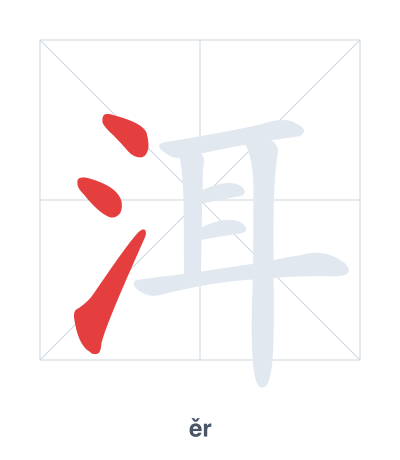
Open Hanzi Writer to see the animated stroke order and practice writing 洱 with real-time feedback.
The character 洱 (ěr) is written with 9 strokes. Follow the standard Chinese stroke order: top to bottom, left to right, outside before inside. The radical 氵 is one of its key components.
Practice the correct stroke order with the Hanzi Writer app to see animated stroke-by-stroke guidance with real-time feedback.
洱 means Er (used in Erhai Lake).
洱 combines the water radical 氵 (shuǐ, 'water') with 耳 (ěr, 'ear') as a phonetic component, indicating pronunciation. The character specifically names Erhai Lake in Yunnan, a large body of water shaped somewhat like an ear.
💡 Memory Tip: Imagine a giant ear floating on a lake, listening to the waves—this is Erhai's watery ear.
我每天都喝普洱茶。
wǒ měi tiān dōu hē pǔ ěr chá
I drink Pu'er tea every day.
大理的洱海非常漂亮。
dà lǐ de ěr hǎi fēi cháng piào liàng
Erhai Lake in Dali is very beautiful.
普洱在中国的云南省。
pǔ ěr zài zhōng guó de yún nán shěng
Pu'er is in Yunnan Province, China.
Open Hanzi Writer to see the animated stroke order and practice writing 洱 with real-time feedback.
✨ Animated stroke order · Handwriting recognition · HSK-graded practice · Free to use
洱 is made of the water radical 氵 on the left and the phonetic component 耳 (ěr, meaning ear) on the right. The water radical indicates that this character is related to a body of water, such as Erhai Lake. The right part gives it its pronunciation ěr.