锇 (é) means "Osmium" in Chinese. It has 12 strokes with the radical 钅.
Rated 4.2/5 in difficulty (advanced).
Appears in 3+ common words including 锇元素 (é yuán sù), 锇粉 (é fěn), 锇酸 (é suān).
Due to its 12 strokes, Hanzi Writer's error detection shows 锇 requires focused practice — most learners need 10+ attempts for consistent accuracy.
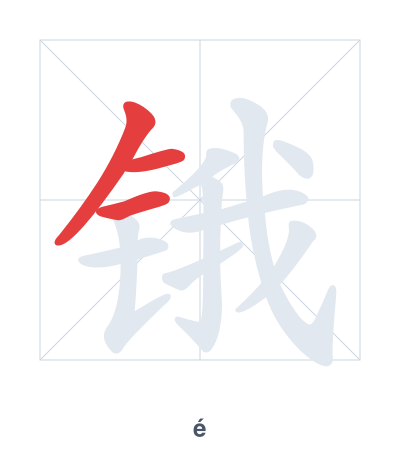
Open Hanzi Writer to see the animated stroke order and practice writing 锇 with real-time feedback.
The character 锇 (é) is written with 12 strokes. Follow the standard Chinese stroke order: top to bottom, left to right, outside before inside. The radical 钅 is one of its key components.
Practice the correct stroke order with the Hanzi Writer app to see animated stroke-by-stroke guidance with real-time feedback.
锇 means Osmium.
锇 is a phono-semantic compound. The left radical 钅 (metal) indicates it is a metallic element, while the right component 我 (originally a pictograph of a weapon, now meaning 'self') provides an approximate pronunciation, as osmium is a hard, dense metal named with a sound close to 'é'.
💡 Memory Tip: Picture a metal (钅) version of yourself (我) made of heavy, shiny osmium, so dense you can barely lift it.
锇是一种化学元素。
é shì yī zhǒng huà xué yuán sù
Osmium is a chemical element.
实验室里有少量锇粉。
shí yàn shì lǐ yǒu shǎo liàng é fěn
There is a small amount of osmium powder in the laboratory.
锇酸具有一定的毒性。
é suān jù yǒu yí dìng de dú xìng
Osmic acid has a certain level of toxicity.
Open Hanzi Writer to see the animated stroke order and practice writing 锇 with real-time feedback.
✨ Animated stroke order · Handwriting recognition · HSK-graded practice · Free to use
The character 锇 combines the radical 钅 (meaning metal or gold) on the left, and the phonetic component 我 (ě, meaning 'I' or 'self') on the right. The radical indicates it is a metal element, while the phonetic part gives a hint to the pronunciation 'é'. This structure is typical for Chinese characters representing chemical elements.