铎 (duó) means "Large bell (ancient instrument)" in Chinese. It has 10 strokes with the radical 钅.
Rated 4.2/5 in difficulty (advanced).
Appears in 3+ common words including 木铎 (mù duó), 铎声 (duó shēng), 铃铎 (líng duó).
Due to its 10 strokes, Hanzi Writer's error detection shows 铎 requires focused practice — most learners need 10+ attempts for consistent accuracy.
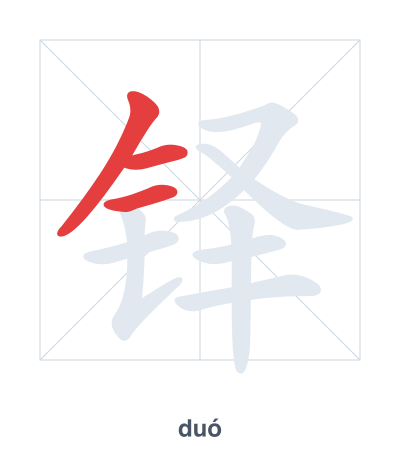
Open Hanzi Writer to see the animated stroke order and practice writing 铎 with real-time feedback.
The character 铎 (duó) is written with 10 strokes. Follow the standard Chinese stroke order: top to bottom, left to right, outside before inside. The radical 钅 is one of its key components.
Practice the correct stroke order with the Hanzi Writer app to see animated stroke-by-stroke guidance with real-time feedback.
铎 means Large bell (ancient instrument).
铎 combines the metal radical 钅 (jīn) with 㐭 (yǒng), which originally depicted a large hanging bell. Together, they represent a large metal bell used in ancient China for issuing orders or warnings.
💡 Memory Tip: Imagine a metal (钅) bell shaped like an upside-down cup (㐭) with a clapper inside, rung by a town crier shouting 'duó!' to gather the crowd.
古代有木铎。
gǔ dài yǒu mù duó
There were wooden-clapper bells in ancient times.
我听到了铎声。
wǒ tīng dào le duó shēng
I heard the sound of a large bell.
庙里挂着铃铎。
miào lǐ guà zhe líng duó
Bells are hanging in the temple.
Open Hanzi Writer to see the animated stroke order and practice writing 铎 with real-time feedback.
✨ Animated stroke order · Handwriting recognition · HSK-graded practice · Free to use
铎 is made of the radical 钍 (jīn, meaning "metal") on the left and the component 睪 (yì) on the right. The metal radical hints that it is a metal object, while the right part gives the sound and relates to the idea of a large bell used in ancient China.