礅 (dūn) means "stone block; pier" in Chinese. It has 17 strokes with the radical 石.
Rated 4.2/5 in difficulty (advanced).
Appears in 3+ common words including 石礅 (shí dūn), 桥礅 (qiáo dūn), 礅子 (dūn zi).
Due to its 17 strokes, Hanzi Writer's error detection shows 礅 requires focused practice — most learners need 10+ attempts for consistent accuracy.
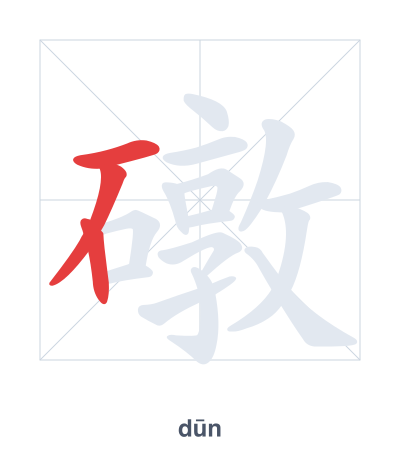
Open Hanzi Writer to see the animated stroke order and practice writing 礅 with real-time feedback.
The character 礅 (dūn) is written with 17 strokes. Follow the standard Chinese stroke order: top to bottom, left to right, outside before inside. The radical 石 is one of its key components.
Practice the correct stroke order with the Hanzi Writer app to see animated stroke-by-stroke guidance with real-time feedback.
礅 means stone block; pier.
礅 is a compound character where the radical 石 (stone) indicates its meaning as a stone block or pier, and 敦 provides the pronunciation dūn while also suggesting a solid, compact shape. Historically, such blocks were used as foundations or piers in construction.
💡 Memory Tip: Picture a man (亻) with a stick (攵) desperately pushing a massive stone block (石) onto a pier, grunting 'dūn!' with effort.
大门口有两个石礅。
dà mén kǒu yǒu liǎng gè shí dūn
There are two stone blocks at the entrance.
这个桥礅非常结实。
zhè ge qiáo dūn fēi cháng jiē shí
This bridge pier is very sturdy.
他坐在礅子上休息。
tā zuò zài dūn zi shàng xiū xī
He is resting on a stone block.
Open Hanzi Writer to see the animated stroke order and practice writing 礅 with real-time feedback.
✨ Animated stroke order · Handwriting recognition · HSK-graded practice · Free to use
礅 is made of the radical 石 (stone) on the left and the phonetic component 敦 on the right. The 石 part directly connects to the meaning "stone block" or "pier." The 敦 part gives the pronunciation dūn but does not contribute to the meaning.