侗 (dòng) means "Dong (ethnic group); ignorant" in Chinese. It has 8 strokes with the radical 亻.
Rated 3.4/5 in difficulty (challenging).
Appears in 3+ common words including 侗族 (dòng zú), 侗戏 (dòng xì), 侗家 (dòng jiā).
Due to its 8 strokes, Hanzi Writer's error detection shows 侗 requires focused practice — most learners need 10+ attempts for consistent accuracy.
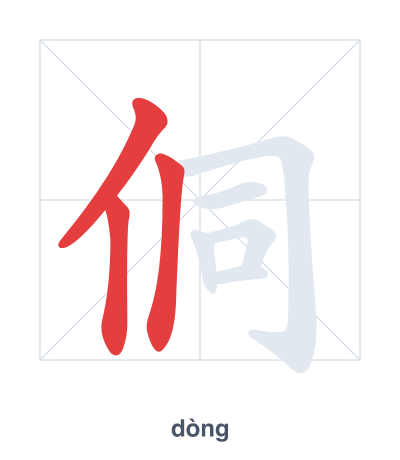
Open Hanzi Writer to see the animated stroke order and practice writing 侗 with real-time feedback.
The character 侗 (dòng) is written with 8 strokes. Follow the standard Chinese stroke order: top to bottom, left to right, outside before inside. The radical 亻 is one of its key components.
Practice the correct stroke order with the Hanzi Writer app to see animated stroke-by-stroke guidance with real-time feedback.
侗 means Dong (ethnic group); ignorant.
The character 侗 combines the radical 亻 (person) with 同 (tóng, 'same') as a phonetic component. Originally, it described someone naive or ignorant, akin to a child who has not yet developed distinct awareness. It is also used phonetically to denote the Dong ethnic group.
💡 Memory Tip: Picture a person (亻) who keeps saying the 'same' (同) thing over and over, revealing their ignorance.
他是侗族人。
tā shì dòng zú rén
He is of the Dong ethnic group.
侗戏很有名。
dòng xì hěn yǒu míng
Dong Opera is very famous.
侗家山寨很漂亮。
dòng jiā shān zhài hěn piào liàng
The Dong ethnic village is very beautiful.
Open Hanzi Writer to see the animated stroke order and practice writing 侗 with real-time feedback.
✨ Animated stroke order · Handwriting recognition · HSK-graded practice · Free to use
侗 is made of two parts: the left radical 亻 (person) and the right part 同 (tóng, meaning same or together). Together, 亻+同 refers to a group of people who are the same — specifically the Dong ethnic group. The less common meaning "ignorant" comes from an old usage where 同 suggests a simple, unsophisticated mind.