岽 (dōng) means "Dong (used in place names in Guangxi)" in Chinese. It has 8 strokes with the radical 山.
Rated 3.7/5 in difficulty (challenging).
Appears in 3+ common words including 岽罗 (dōng luó), 岽王 (dōng wáng), 岽那 (dōng nà).
Due to its 8 strokes, Hanzi Writer's error detection shows 岽 requires focused practice — most learners need 10+ attempts for consistent accuracy.
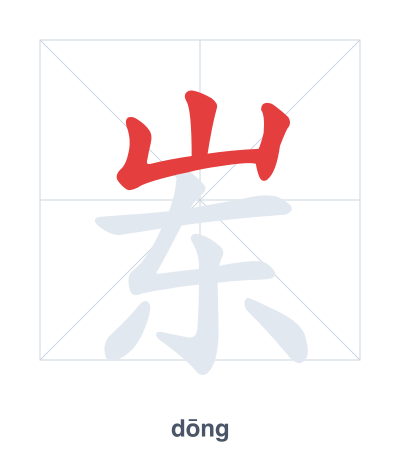
Open Hanzi Writer to see the animated stroke order and practice writing 岽 with real-time feedback.
The character 岽 (dōng) is written with 8 strokes. Follow the standard Chinese stroke order: top to bottom, left to right, outside before inside. The radical 山 is one of its key components.
Practice the correct stroke order with the Hanzi Writer app to see animated stroke-by-stroke guidance with real-time feedback.
岽 means Dong (used in place names in Guangxi).
岽 is a phono-semantic compound combining the radical 山 (mountain) with 东 (east) as a phonetic component. It is used in place names in Guangxi, often referring to a mountain or hill in the east. The character's structure visually suggests an eastern mountain, though its meaning is purely toponymic.
💡 Memory Tip: Imagine a mountain (山) in the east (东) that's so distinctive it gets its own name, like "Eastern Peak" (岽).
岽罗是一个地名。
dōng luó shì yí gè dì míng
Dongluo is a place name.
这里叫岽王村。
zhè lǐ jiào dōng wáng cūn
This place is called Dongwang Village.
岽那在广西。
dōng nà zài guǎng xī
Dongna is in Guangxi.
Open Hanzi Writer to see the animated stroke order and practice writing 岽 with real-time feedback.
✨ Animated stroke order · Handwriting recognition · HSK-graded practice · Free to use
岽 is made of the radical 山 (mountain) on top and 东 (dōng, meaning east) underneath. The 山 radical suggests that 岽 is used in place names related to mountains or hills in Guangxi. The phonetic component 东 gives the character its pronunciation dōng.