琮 (cóng) means "Octagonal jade badge" in Chinese. It has 12 strokes with the radical 王.
Rated 4.2/5 in difficulty (advanced).
Appears in 3+ common words including 玉琮 (yù cóng), 琮琮 (cóng cóng), 琮玺 (cóng xǐ).
Due to its 12 strokes, Hanzi Writer's error detection shows 琮 requires focused practice — most learners need 10+ attempts for consistent accuracy.
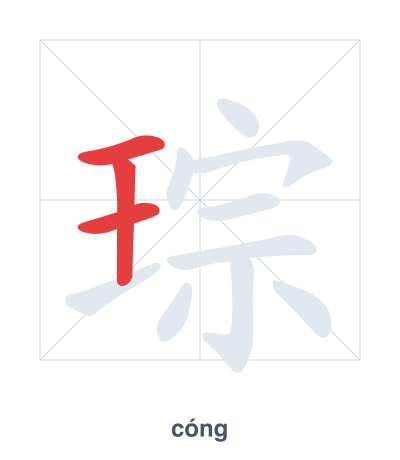
Open Hanzi Writer to see the animated stroke order and practice writing 琮 with real-time feedback.
The character 琮 (cóng) is written with 12 strokes. Follow the standard Chinese stroke order: top to bottom, left to right, outside before inside. The radical 王 is one of its key components.
Practice the correct stroke order with the Hanzi Writer app to see animated stroke-by-stroke guidance with real-time feedback.
琮 means Octagonal jade badge.
The character 琮 combines the jade radical (王) with the phonetic component 宗 (zōng), originally referring to a cylindrical or octagonal jade artifact used in ancient Chinese rituals to symbolize the earth and communicate with ancestors.
💡 Memory Tip: Picture a jade (王) octagonal badge resting on an ancestral altar (宗) during a ceremony.
这个玉琮很古老。
zhè ge yù cóng hěn gǔ lǎo
This jade ritual tube is very ancient.
泉水琮琮地流。
quán shuǐ cóng cóng dì liú
The spring water flows with a tinkling sound like jade.
琮玺是古代印章。
cóng xǐ shì gǔ dài yìn zhāng
A Cong seal is an ancient seal.
Open Hanzi Writer to see the animated stroke order and practice writing 琮 with real-time feedback.
✨ Animated stroke order · Handwriting recognition · HSK-graded practice · Free to use
The left side is the radical 王 (yù), meaning jade, which indicates that the character is related to jade objects. The right side is 宗 (zōng), which provides the pronunciation and originally meant 'ancestor' or 'clan'. Together, 琮 refers to an octagonal jade ritual vessel used in ancient ceremonies.