茨 (cí) means "thatch" in Chinese. It has 9 strokes with the radical 艹.
Rated 4/5 in difficulty (challenging).
Appears in 3+ common words including 茨菰 (cí gū), 茅茨 (máo cí), 茨冈 (cí gāng).
Due to its 9 strokes, Hanzi Writer's error detection shows 茨 requires focused practice — most learners need 10+ attempts for consistent accuracy.
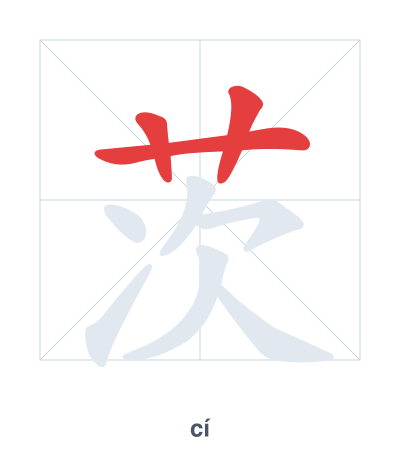
Open Hanzi Writer to see the animated stroke order and practice writing 茨 with real-time feedback.
The character 茨 (cí) is written with 9 strokes. Follow the standard Chinese stroke order: top to bottom, left to right, outside before inside. The radical 艹 is one of its key components.
Practice the correct stroke order with the Hanzi Writer app to see animated stroke-by-stroke guidance with real-time feedback.
茨 means thatch.
茨 (cí) combines the grass radical 艹 with 次, which provides phonetic and semantic hints. Originally it referred to a thatch roof or thorny plants like Tribulus terrestris, with the grass component indicating plant material and 次 suggesting the layered arrangement of thatch.
💡 Memory Tip: Imagine a thatched roof where the grass (艹) is laid in neat, orderly rows (次) to keep out rain.
这种茨菰很好吃。
zhè zhǒng cí gū hěn hǎo chī
This arrowhead tuber is very delicious.
山里有一间茅茨。
shān lǐ yǒu yī jiān máo cí
There is a thatched cottage in the mountains.
他喜欢茨冈音乐。
tā xǐ huān cí gāng yīn yuè
He likes Gypsy music.
Open Hanzi Writer to see the animated stroke order and practice writing 茨 with real-time feedback.
✨ Animated stroke order · Handwriting recognition · HSK-graded practice · Free to use
茨 is made of the grass radical 艹 on top and 次 (cì, meaning "next" or "order") below. The grass radical hints that the character relates to plants, while 次 adds the sound. Together, 茨 means "thatch," which is a type of grass used for roofing.