槌 (chuí) means "Hammer" in Chinese. It has 13 strokes with the radical 木.
Rated 4.2/5 in difficulty (advanced).
Appears in 3+ common words including 鼓槌 (gǔ chuí), 木槌 (mù chuí), 槌打 (chuí dǎ).
Due to its 13 strokes, Hanzi Writer's error detection shows 槌 requires focused practice — most learners need 10+ attempts for consistent accuracy.
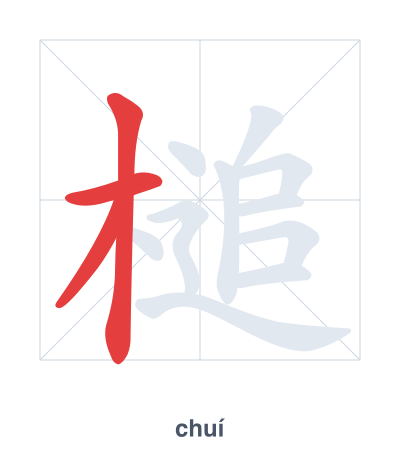
Open Hanzi Writer to see the animated stroke order and practice writing 槌 with real-time feedback.
The character 槌 (chuí) is written with 13 strokes. Follow the standard Chinese stroke order: top to bottom, left to right, outside before inside. The radical 木 is one of its key components.
Practice the correct stroke order with the Hanzi Writer app to see animated stroke-by-stroke guidance with real-time feedback.
槌 means Hammer.
槌 is a compound character where the left radical 木 (wood) indicates the object is made of wood, like a wooden hammer or mallet. The right component 追 (zhuī, 'chase') primarily serves as a phonetic element, giving the character its pronunciation chuí.
💡 Memory Tip: Picture a wooden hammer (木) chasing (追) a nail across the floor, pounding it in with every strike.
他用鼓槌敲鼓。
tā yòng gǔ chuí qiāo gǔ
He used drumsticks to beat the drum.
法官拿起了木槌。
fǎ guān ná qǐ le mù chuí
The judge picked up the gavel.
槌打的声音很大。
chuí dǎ dī shēng yīn hěn dà
The sound of hammering is very loud.
Open Hanzi Writer to see the animated stroke order and practice writing 槌 with real-time feedback.
✨ Animated stroke order · Handwriting recognition · HSK-graded practice · Free to use
槌 is made of the radical 木 (wood) on the left, showing the object is made of wood. The right part 追 (zhuī) gives the sound chuí, but it also suggests the action of striking or chasing, which fits a hammer's use.