怵 (chù) means "to fear; to be afraid" in Chinese. It has 8 strokes with the radical 忄.
Rated 3.7/5 in difficulty (challenging).
Appears in 3+ common words including 发怵 (fā chù), 怵头 (chù tóu), 惊怵 (jīng chù).
Due to its 8 strokes, Hanzi Writer's error detection shows 怵 requires focused practice — most learners need 10+ attempts for consistent accuracy.
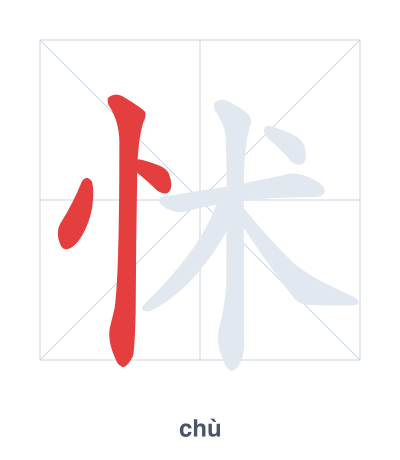
Open Hanzi Writer to see the animated stroke order and practice writing 怵 with real-time feedback.
The character 怵 (chù) is written with 8 strokes. Follow the standard Chinese stroke order: top to bottom, left to right, outside before inside. The radical 忄 is one of its key components.
Practice the correct stroke order with the Hanzi Writer app to see animated stroke-by-stroke guidance with real-time feedback.
怵 means to fear; to be afraid.
怵 is a phono-semantic compound combining the heart radical 忄 (heart/mind) with 术 (shù, originally meaning 'art' or 'technique') as a phonetic hint. The heart radical indicates the emotion of fear arises from within, while the phonetic approximates the sound chù.
💡 Memory Tip: Picture a heart (忄) next to a tree (木) with a drop of blood (丶) on it—you fear that the tree is bleeding, a truly alarming sight.
我心里有点发怵。
wǒ xīn lǐ yǒu diǎn fā chù
I feel a bit nervous.
考试让他很怵头。
kǎo shì ràng tā hěn chù tóu
He is very apprehensive about the exam.
画面让人惊怵。
huà miàn ràng rén jīng chù
The scene is terrifying.
Open Hanzi Writer to see the animated stroke order and practice writing 怵 with real-time feedback.
✨ Animated stroke order · Handwriting recognition · HSK-graded practice · Free to use
怵 is made of the heart radical 忄 on the left and the component 术 on the right. The heart radical indicates that the meaning involves an emotion, and 术 gives a rough phonetic clue for the sound "chu".