椆 (chóu) means "Evergreen oak" in Chinese. It has 12 strokes with the radical 木.
Rated 4.2/5 in difficulty (advanced).
Appears in 3+ common words including 椆木 (chóu mù), 椆树 (chóu shù), 椆子 (chóu zi).
Due to its 12 strokes, Hanzi Writer's error detection shows 椆 requires focused practice — most learners need 10+ attempts for consistent accuracy.
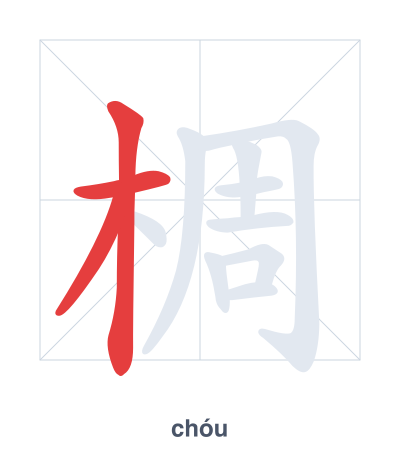
Open Hanzi Writer to see the animated stroke order and practice writing 椆 with real-time feedback.
The character 椆 (chóu) is written with 12 strokes. Follow the standard Chinese stroke order: top to bottom, left to right, outside before inside. The radical 木 is one of its key components.
Practice the correct stroke order with the Hanzi Writer app to see animated stroke-by-stroke guidance with real-time feedback.
椆 means Evergreen oak.
椆 is a compound character: the radical 木 (tree) indicates it is a type of tree, while 周 (zhōu, meaning circumference or cycle) serves as a phonetic component and also hints at the dense, ringed wood grain of the evergreen oak.
💡 Memory Tip: Imagine a tree (木) with tight, circular rings (周) that make it a sturdy evergreen oak.
椆木质地很硬。
chóu mù zhì dì hěn yìng
Evergreen oak wood is very hard in texture.
山上有很多椆树。
shān shàng yǒu hěn duō chóu shù
There are many evergreen oaks on the mountain.
椆子可以做工具。
chóu zi kě yǐ zuò gōng jù
Evergreen oak wood can be used to make tools.
Open Hanzi Writer to see the animated stroke order and practice writing 椆 with real-time feedback.
✨ Animated stroke order · Handwriting recognition · HSK-graded practice · Free to use
椆 is composed of the radical 木 (wood/tree) on the left and the phonetic component 周 (zhōu) on the right. The 木 radical directly indicates that the character refers to a type of tree, while 周 provides a hint to the pronunciation chóu. Together, they form the meaning 'evergreen oak'.