呎 (chǐ) means "foot (unit of length)" in Chinese. It has 7 strokes with the radical 口.
Rated 3.5/5 in difficulty (challenging).
Appears in 3+ common words including 英呎 (yīng chǐ), 平方呎 (píng fāng chǐ), 呎吋 (chǐ cùn).
Due to its 7 strokes, Hanzi Writer's error detection shows 呎 requires focused practice — most learners need 10+ attempts for consistent accuracy.
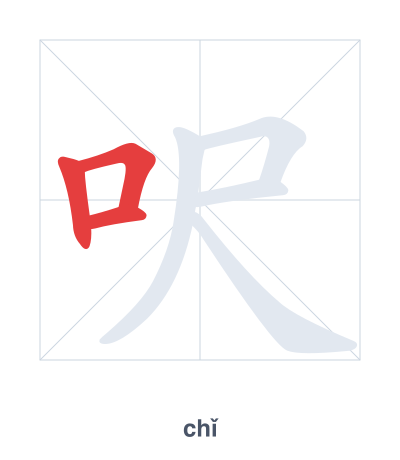
Open Hanzi Writer to see the animated stroke order and practice writing 呎 with real-time feedback.
The character 呎 (chǐ) is written with 7 strokes. Follow the standard Chinese stroke order: top to bottom, left to right, outside before inside. The radical 口 is one of its key components.
Practice the correct stroke order with the Hanzi Writer app to see animated stroke-by-stroke guidance with real-time feedback.
呎 means foot (unit of length).
This character is a phono-semantic compound: the radical 口 (mouth) suggests a unit of measurement (as in similar characters like 吋 for 'inch'), while 尺 (chǐ) provides the sound and core meaning of a length unit. Combined, they denote the 'foot' unit, a foreign measure adapted into Chinese by adding the mouth radical to distinguish it from the native 尺.
💡 Memory Tip: Picture an open mouth (口) that is exactly one foot (尺) wide, so you use it to measure a foot.
他的身高是五英呎。
tā de shēn gāo shì wǔ yīng chǐ
His height is five feet.
房子有六百平方呎。
fáng zi yǒu liù bǎi píng fāng chǐ
The house is six hundred square feet.
这件衣服的呎吋很大。
zhè jiàn yī fú de chǐ cùn hěn dà
The size of this garment is very large.
Open Hanzi Writer to see the animated stroke order and practice writing 呎 with real-time feedback.
✨ Animated stroke order · Handwriting recognition · HSK-graded practice · Free to use
呎 is made of two parts: the radical 口 (mouth) on the left, and 尺 (chǐ, ruler) on the right. The right part 尺 gives the meaning of measurement, and 口 acts as a phonetic component or simply a structural part. Together, they represent a unit of length called 'foot'.