蚩 (chī) means "ignorant; worm-like" in Chinese. It has 10 strokes with the radical 虫.
Rated 4.2/5 in difficulty (advanced).
Appears in 3+ common words including 蚩尤 (chī yóu), 蚩蚩 (chī chī), 妍蚩 (yán chī).
Due to its 10 strokes, Hanzi Writer's error detection shows 蚩 requires focused practice — most learners need 10+ attempts for consistent accuracy.
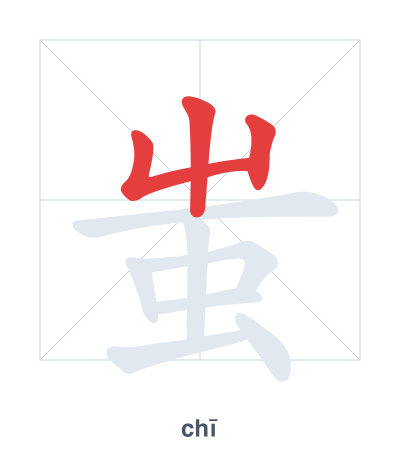
Open Hanzi Writer to see the animated stroke order and practice writing 蚩 with real-time feedback.
The character 蚩 (chī) is written with 10 strokes. Follow the standard Chinese stroke order: top to bottom, left to right, outside before inside. The radical 虫 is one of its key components.
Practice the correct stroke order with the Hanzi Writer app to see animated stroke-by-stroke guidance with real-time feedback.
蚩 means ignorant; worm-like.
蚩 combines the radical 虫 (worm/insect) with 㞢, an ancient form of 之 suggesting movement, together portraying a crawling worm. This worm-like imagery led to the meaning 'ignorant' or 'simple-minded', as worms are seen as lowly creatures.
💡 Memory Tip: Picture a worm (虫) with a foot (㞢) that is so ignorant it keeps stepping on its own tail.
蚩尤是中国神话人物。
chī yóu shì zhōng guó shén huà rén wù
Chiyou is a figure in Chinese mythology.
他的样子看起来蚩蚩的。
tā de yàng zi kàn qǐ lái chī chī de
He looks very simple and honest.
这种事很难分清妍蚩。
zhè zhǒng shì hěn nán fēn qīng yán chī
It is hard to distinguish between the beautiful and the ugly in this matter.
Open Hanzi Writer to see the animated stroke order and practice writing 蚩 with real-time feedback.
✨ Animated stroke order · Handwriting recognition · HSK-graded practice · Free to use
蚩 is composed of the radical 虫 (insect or worm) on top and the component 㞢 below. The insect radical hints at the meaning "worm-like," while the lower part gives the character its overall shape and sound. Together they form a character originally describing something crawling or ignorant.