晟 (chéng) means "Bright and prosperous" in Chinese. It has 10 strokes with the radical 日.
Rated 4.2/5 in difficulty (advanced).
Appears in 3+ common words including 晟世 (chéng shì), 晟睿 (chéng ruì), 晟明 (chéng míng).
Due to its 10 strokes, Hanzi Writer's error detection shows 晟 requires focused practice — most learners need 10+ attempts for consistent accuracy.
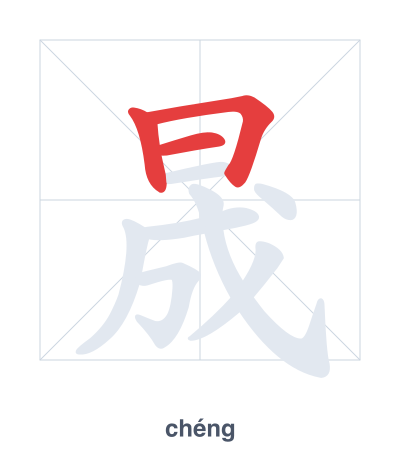
Open Hanzi Writer to see the animated stroke order and practice writing 晟 with real-time feedback.
The character 晟 (chéng) is written with 10 strokes. Follow the standard Chinese stroke order: top to bottom, left to right, outside before inside. The radical 日 is one of its key components.
Practice the correct stroke order with the Hanzi Writer app to see animated stroke-by-stroke guidance with real-time feedback.
晟 means Bright and prosperous.
晟 combines the sun (日) with 成 (chéng, 'to accomplish'), suggesting that when the sun achieves its fullest brightness, it brings prosperity. The character thus visually represents the idea of bright and thriving conditions under a radiant sun.
💡 Memory Tip: The sun (日) accomplishes (成) a brilliant, prosperous glow over the land.
这是一个晟世。
zhè shì yí gè chéng shì
This is a prosperous age.
他的名字叫晟睿。
tā de míng zì jiào chéng ruì
His name is Shengrui.
晟明代表光明。
chéng míng dài biǎo guāng míng
'Shengming' represents brightness.
Open Hanzi Writer to see the animated stroke order and practice writing 晟 with real-time feedback.
✨ Animated stroke order · Handwriting recognition · HSK-graded practice · Free to use
晟 is made of 日 (sun) on top and 成 (chéng, to succeed) below. The sun represents brightness, while 成 implies completion or achievement, together creating the meaning of bright and prosperous.