榇 (chèn) means "Coffin" in Chinese. It has 13 strokes with the radical 木.
Rated 4.2/5 in difficulty (advanced).
Appears in 3+ common words including 榇木 (chèn mù), 灵榇 (líng chèn), 榇托 (chèn tuō).
Due to its 13 strokes, Hanzi Writer's error detection shows 榇 requires focused practice — most learners need 10+ attempts for consistent accuracy.
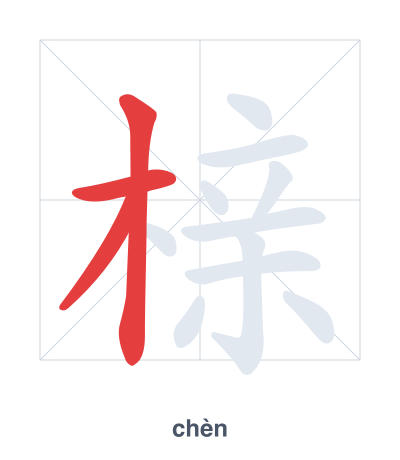
Open Hanzi Writer to see the animated stroke order and practice writing 榇 with real-time feedback.
The character 榇 (chèn) is written with 13 strokes. Follow the standard Chinese stroke order: top to bottom, left to right, outside before inside. The radical 木 is one of its key components.
Practice the correct stroke order with the Hanzi Writer app to see animated stroke-by-stroke guidance with real-time feedback.
榇 means Coffin.
榇 combines the wood radical 木 with 亲 (close relative), forming a wooden container for a deceased relative. It originally referred to a coffin, typically made of wood, used to bury one's kin.
💡 Memory Tip: Picture a wooden coffin (木) holding your dear (亲) relative, marked by the character 榇.
这种木材叫榇木。
zhè zhǒng mù cái jiào chèn mù
This wood is called coffin wood.
人们送别灵榇。
rén men sòng bié líng chèn
People saw off the coffin.
这是底部的榇托。
zhè shì dǐ bù de chèn tuō
This is the support at the bottom.
Open Hanzi Writer to see the animated stroke order and practice writing 榇 with real-time feedback.
✨ Animated stroke order · Handwriting recognition · HSK-graded practice · Free to use
榇 is composed of 木 (wood) on the left and 亲 (qīn, relative) on the right. The wood radical indicates the material, while 亲 suggests the coffin's connection to a deceased loved one. Together, they form the concept of a wooden container for a relative's body.