宸 (chén) means "Imperial / Emperor's palace" in Chinese. It has 10 strokes with the radical 宀.
Rated 4.2/5 in difficulty (advanced).
Appears in 3+ common words including 宸极 (chén jí), 宸衷 (chén zhōng), 宸翰 (chén hàn).
Due to its 10 strokes, Hanzi Writer's error detection shows 宸 requires focused practice — most learners need 10+ attempts for consistent accuracy.
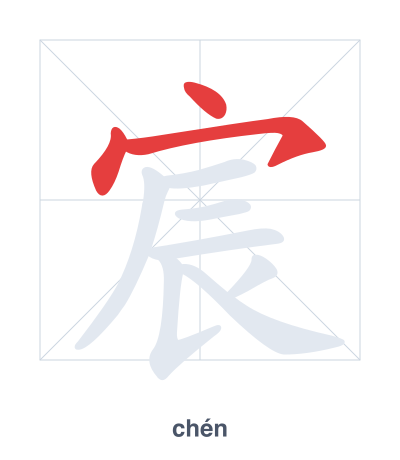
Open Hanzi Writer to see the animated stroke order and practice writing 宸 with real-time feedback.
The character 宸 (chén) is written with 10 strokes. Follow the standard Chinese stroke order: top to bottom, left to right, outside before inside. The radical 宀 is one of its key components.
Practice the correct stroke order with the Hanzi Writer app to see animated stroke-by-stroke guidance with real-time feedback.
宸 means Imperial / Emperor's palace.
宸 combines the radical 宀 (roof) with 辰 as a phonetic component. The character originally referred to the deep eaves of the emperor's palace, later extending to mean the imperial palace itself, where the emperor resides under the celestial canopy.
💡 Memory Tip: Imagine a grand roof (宀) sheltering the Emperor's throne, with the 辰 below representing the morning star that rises only for him.
宸极指北极星。
chén jí zhǐ běi jí xīng
"Chenji" refers to the North Star.
宸衷是皇帝的心意。
chén zhōng shì huáng dì de xīn yì
"Chenzhong" refers to the Emperor's inner thoughts.
宸翰是皇帝的字。
chén hàn shì huáng dì de zì
"Chenhan" refers to the Emperor's handwriting.
Open Hanzi Writer to see the animated stroke order and practice writing 宸 with real-time feedback.
✨ Animated stroke order · Handwriting recognition · HSK-graded practice · Free to use
宸 has two parts: the radical 宀 (roof) on top, and 辰 (star or time) below. The roof radical suggests a building, while 辰 refers to the North Star, which ancient Chinese emperors used as a symbol of their central authority. Together, they represent the emperor's palace or residence, tying the idea of imperial power to the celestial north star.