坼 (chè) means "to crack; to split" in Chinese. It has 8 strokes with the radical 土.
Rated 3.7/5 in difficulty (challenging).
Appears in 3+ common words including 坼裂 (chè liè), 龟坼 (guī chè), 崩坼 (bēng chè).
Due to its 8 strokes, Hanzi Writer's error detection shows 坼 requires focused practice — most learners need 10+ attempts for consistent accuracy.
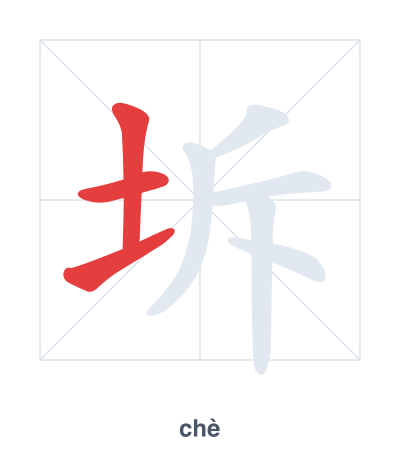
Open Hanzi Writer to see the animated stroke order and practice writing 坼 with real-time feedback.
The character 坼 (chè) is written with 8 strokes. Follow the standard Chinese stroke order: top to bottom, left to right, outside before inside. The radical 土 is one of its key components.
Practice the correct stroke order with the Hanzi Writer app to see animated stroke-by-stroke guidance with real-time feedback.
坼 means to crack; to split.
坼 combines the radical 土 (earth) with 斥 (chì, originally showing a crack splitting apart), together indicating the earth cracking or splitting open. Its ancient form may have depicted a fissure in the ground.
💡 Memory Tip: Imagine the earth (土) being split by a sharp axe (斤 inside 斥) that leaves a deep crack (丶).
墙壁发生了坼裂。
qiáng bì fā shēng le chè liè
The wall has cracked.
土地因为干旱而龟坼。
tǔ dì yīn wèi gān hàn ér guī chè
The land is cracked due to drought.
山石突然崩坼了。
shān shí tū rán bēng chè le
The mountain rocks suddenly cracked and collapsed.
Open Hanzi Writer to see the animated stroke order and practice writing 坼 with real-time feedback.
✨ Animated stroke order · Handwriting recognition · HSK-graded practice · Free to use
The character 坼 is composed of two parts: the radical 土 (earth) on the left and the component 斥 (to reject or expand) on the right. Together, they suggest the idea of earth expanding or being forced apart, which leads to cracking or splitting. This structural combination directly reflects the meaning "to crack; to split."