惝 (chǎng) means "alarmed; disappointed" in Chinese. It has 11 strokes with the radical 忄.
Rated 4.2/5 in difficulty (advanced).
Appears in 3+ common words including 惝恍 (chǎng huǎng), 惝然 (chǎng rán), 惝怳 (chǎng huǎng).
Due to its 11 strokes, Hanzi Writer's error detection shows 惝 requires focused practice — most learners need 10+ attempts for consistent accuracy.
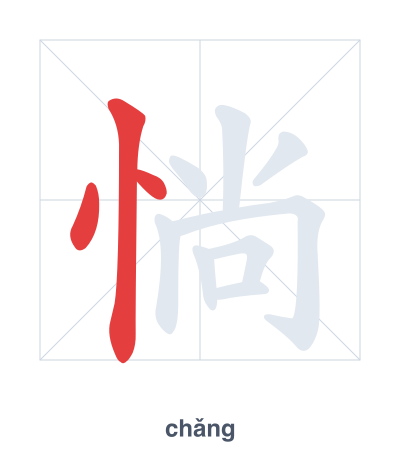
Open Hanzi Writer to see the animated stroke order and practice writing 惝 with real-time feedback.
The character 惝 (chǎng) is written with 11 strokes. Follow the standard Chinese stroke order: top to bottom, left to right, outside before inside. The radical 忄 is one of its key components.
Practice the correct stroke order with the Hanzi Writer app to see animated stroke-by-stroke guidance with real-time feedback.
惝 means alarmed; disappointed.
惝 is a compound character with the heart radical (忄) indicating an emotional state, and the phonetic component 尚 (shàng). The combination suggests a heart feeling lost or unsettled, as if still in a daze—reflecting meanings of alarm or disappointment.
💡 Memory Tip: Imagine a heart (忄) alarmed because it's stuck inside a narrow 'shang' (尚) hallway, feeling disappointed it can't find the way out.
梦境显得有些惝恍。
mèng jìng xiǎn de yǒu xiē chǎng huǎng
The dreamscape appeared somewhat blurred and uncertain.
他惝然若失地站着。
tā chǎng rán ruò shī dì zhàn zhe
He stood there feeling dazed and lost.
他的神志有些惝怳。
tā de shén zhì yǒu xiē chǎng huǎng
His mind is somewhat distraught.
Open Hanzi Writer to see the animated stroke order and practice writing 惝 with real-time feedback.
✨ Animated stroke order · Handwriting recognition · HSK-graded practice · Free to use
惝 is a phono-semantic compound. The left side, 忄, is the heart radical, showing the character relates to emotions like alarm or disappointment. The right side, 尚 (shàng), gives the pronunciation and adds a sense of 'still' or 'yet,' as in a lingering feeling.