锸 (chā) means "spade; shovel" in Chinese. It has 14 strokes with the radical 钅.
Rated 4.2/5 in difficulty (advanced).
Appears in 3+ common words including 铁锸 (tiě chā), 锸土 (chā tǔ), 锸入 (chā rù).
Due to its 14 strokes, Hanzi Writer's error detection shows 锸 requires focused practice — most learners need 10+ attempts for consistent accuracy.
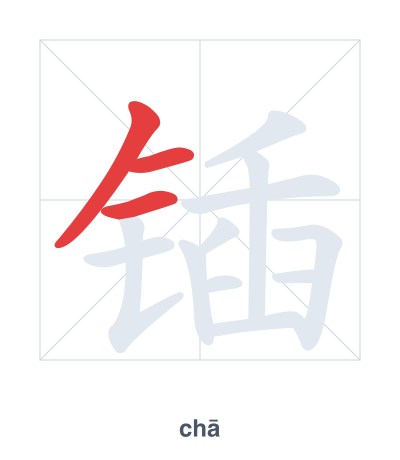
Open Hanzi Writer to see the animated stroke order and practice writing 锸 with real-time feedback.
The character 锸 (chā) is written with 14 strokes. Follow the standard Chinese stroke order: top to bottom, left to right, outside before inside. The radical 钅 is one of its key components.
Practice the correct stroke order with the Hanzi Writer app to see animated stroke-by-stroke guidance with real-time feedback.
锸 means spade; shovel.
锸 is a phono-semantic compound combining the metal radical 钅 (jīn), indicating the tool is made of metal, with 臿 (chā), which originally depicted a hand thrusting a pestle into a mortar—a motion of inserting or digging. Together, they convey a metal digging tool: a spade or shovel.
💡 Memory Tip: Picture a metal spade (钅) plunging into a mortar (臼) to scoop out a thousand (千) grains of rice—a shovel digging up a thousand treasures.
他拿着铁锸去干活。
tā ná zhe tiě chā qù gàn huó
He went to work with an iron spade.
用锸土的方法种树。
yòng chā tǔ de fāng fǎ zhòng shù
Plant trees by digging into the soil with a spade.
把铁锸入土里。
bǎ tiě chā rù tǔ lǐ
Plunge the iron spade into the ground.
Open Hanzi Writer to see the animated stroke order and practice writing 锸 with real-time feedback.
✨ Animated stroke order · Handwriting recognition · HSK-graded practice · Free to use
锸 combines the radical 钅 (gold/metal) on the left and the phonetic component 臿 (chā) on the right. The radical indicates that a spade or shovel is typically made of metal. The right part 臿 gives a clue to the pronunciation and originally related to inserting or digging.