梣 (cén) means "ash tree" in Chinese. It has 11 strokes with the radical 木.
Rated 4.2/5 in difficulty (advanced).
Appears in 3+ common words including 梣树 (cén shù), 梣木 (cén mù), 梣皮 (cén pí).
Due to its 11 strokes, Hanzi Writer's error detection shows 梣 requires focused practice — most learners need 10+ attempts for consistent accuracy.
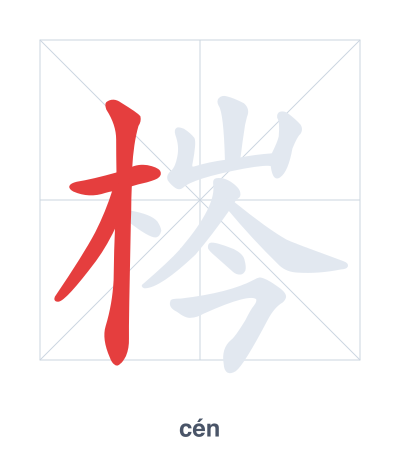
Open Hanzi Writer to see the animated stroke order and practice writing 梣 with real-time feedback.
The character 梣 (cén) is written with 11 strokes. Follow the standard Chinese stroke order: top to bottom, left to right, outside before inside. The radical 木 is one of its key components.
Practice the correct stroke order with the Hanzi Writer app to see animated stroke-by-stroke guidance with real-time feedback.
梣 means ash tree.
梣 is a phono-semantic compound combining the radical 木 (tree) with 岑 (cén, steep hill) as a phonetic hint. The ash tree was associated with mountainous or hilly landscapes, so the right component subtly reinforces the meaning.
💡 Memory Tip: Imagine an ash tree (木) growing on a steep hill (岑: 山 on top, 今 below) where you are standing right now.
院子里有一棵梣树。
yuàn zi lǐ yǒu yī kē cén shù
There is an ash tree in the yard.
梣木的质地很硬。
cén mù de zhì dì hěn yìng
Ash wood has a very hard texture.
梣皮可以用来做药。
cén pí kě yǐ yòng lái zuò yào
Ash bark can be used to make medicine.
Open Hanzi Writer to see the animated stroke order and practice writing 梣 with real-time feedback.
✨ Animated stroke order · Handwriting recognition · HSK-graded practice · Free to use
梣 is a phono-semantic compound. The left radical 木 means 'tree' or 'wood,' which gives the meaning of a type of tree. The right part 岑 (cén) provides the pronunciation and originally meant 'small hill,' but here it mainly acts as a phonetic component.