埔 (bù/pǔ) means "Plain; level ground." in Chinese. It has 10 strokes with the radical 土.
Rated 4.2/5 in difficulty (advanced).
Appears in 3+ common words including 黄埔 (huáng pǔ), 埔里 (pǔ lǐ), 大埔 (dà bù).
Due to its 10 strokes, Hanzi Writer's error detection shows 埔 requires focused practice — most learners need 10+ attempts for consistent accuracy.
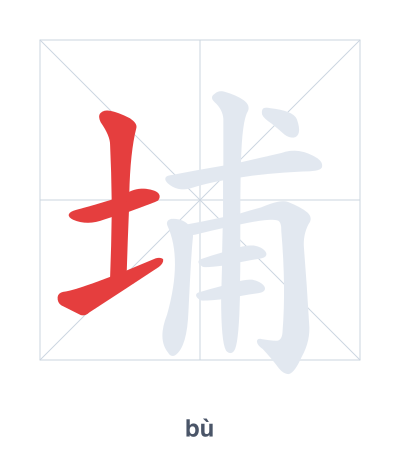
Open Hanzi Writer to see the animated stroke order and practice writing 埔 with real-time feedback.
The character 埔 (bù/pǔ) is written with 10 strokes. Follow the standard Chinese stroke order: top to bottom, left to right, outside before inside. The radical 土 is one of its key components.
Practice the correct stroke order with the Hanzi Writer app to see animated stroke-by-stroke guidance with real-time feedback.
埔 means Plain; level ground..
This is a polyphonic character with readings: bù, pǔ.
埔 is a phono-semantic compound: the radical 土 (earth) indicates it relates to land, while 甫 (fǔ) provides pronunciation. Together, they describe a flat, open stretch of ground (plain).
💡 Memory Tip: Picture a farmer (甫) standing on a wide, level field of earth (土), surveying the plain before him.
我去过黄埔。
wǒ qù guò huáng pǔ
I have been to Huangpu.
埔里的风景很美。
pǔ lǐ de fēng jǐng hěn měi
The scenery in Puli is very beautiful.
他住在大埔。
tā zhù zài dà bù
He lives in Tai Po.
Open Hanzi Writer to see the animated stroke order and practice writing 埔 with real-time feedback.
✨ Animated stroke order · Handwriting recognition · HSK-graded practice · Free to use
埔 is made of the radical 土 (earth) on the left and 甫 on the right. The radical suggests the character relates to land or ground, while 甫 adds the pronunciation bǔ. Together, 埔 means a flat area or plain.