礤 (cǎ) means "grater" in Chinese. It has 19 strokes with the radical 石.
Rated 4.2/5 in difficulty (advanced).
Appears in 3+ common words including 礤床 (cǎ chuáng), 礤子 (cǎ zi), 礤菜 (cǎ cài).
Due to its 19 strokes, Hanzi Writer's error detection shows 礤 requires focused practice — most learners need 10+ attempts for consistent accuracy.
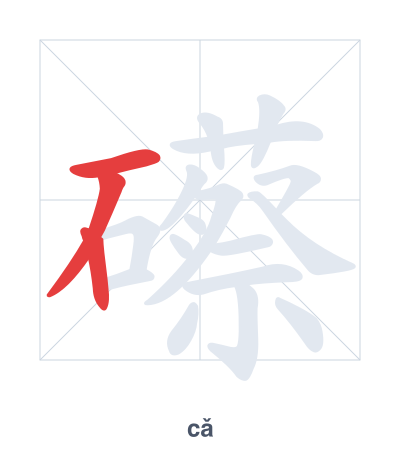
Open Hanzi Writer to see the animated stroke order and practice writing 礤 with real-time feedback.
The character 礤 (cǎ) is written with 19 strokes. Follow the standard Chinese stroke order: top to bottom, left to right, outside before inside. The radical 石 is one of its key components.
Practice the correct stroke order with the Hanzi Writer app to see animated stroke-by-stroke guidance with real-time feedback.
礤 means grater.
礤 is a phono-semantic compound. The radical 石 (stone) indicates the traditional material for a grater, while the component 察 (cǎ, originally chá) provides a phonetic hint.
💡 Memory Tip: Picture a stone (石) grater that lets you examine (察) every shred of carrot as it falls through the rough surface.
用礤床切土豆丝。
yòng cǎ chuáng qiè tǔ dòu sī
Shred potatoes with a grater.
这个礤子很好用。
zhè ge cǎ zi hěn hǎo yòng
This grater is very handy.
他在厨房里礤菜。
tā zài chú fáng lǐ cǎ cài
He is shredding vegetables with a grater in the kitchen.
Open Hanzi Writer to see the animated stroke order and practice writing 礤 with real-time feedback.
✨ Animated stroke order · Handwriting recognition · HSK-graded practice · Free to use
礤 is composed of the radical 石 (stone) on the left and the phonetic component 察 (chá, meaning to inspect) on the right. The stone radical relates to the idea of a hard, rough surface used for grating, while the right side hints at the pronunciation cǎ, though its meaning doesn't directly contribute.