豳 (bīn) means "Bin (ancient place name)" in Chinese. It has 17 strokes with the radical 豕.
Rated 3.9/5 in difficulty (challenging).
Appears in 3+ common words including 豳风 (bīn fēng), 豳州 (bīn zhōu), 豳土 (bīn tǔ).
Due to its 17 strokes, Hanzi Writer's error detection shows 豳 requires focused practice — most learners need 10+ attempts for consistent accuracy.
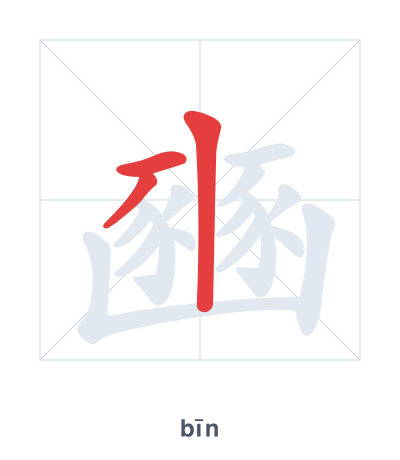
Open Hanzi Writer to see the animated stroke order and practice writing 豳 with real-time feedback.
The character 豳 (bīn) is written with 17 strokes. Follow the standard Chinese stroke order: top to bottom, left to right, outside before inside. The radical 豕 is one of its key components.
Practice the correct stroke order with the Hanzi Writer app to see animated stroke-by-stroke guidance with real-time feedback.
豳 means Bin (ancient place name).
| Character | 豳 |
| Pinyin | bīn (bin) |
| Meaning | Bin (ancient place name) |
| Strokes | 17 |
| Radical | 豕 |
| Difficulty | 3.9/5 |
豳 is a compound of two pig symbols (豕) sandwiching a mountain (山), representing the ancient place where pigs were herded in mountainous terrain, historically the early Zhou capital.
💡 Memory Tip: Picture two pigs (豕 豕) struggling up a mountain (山) to reach the ancient city of Bin.
他在读《豳风》。
tā zài dú bīn fēng
He is reading 'Odes of Bin'.
这里古称豳州。
zhè lǐ gǔ chēng bīn zhōu
This place was anciently called Binzhou.
豳土非常肥沃。
bīn tǔ fēi cháng féi wò
The land of Bin is very fertile.
Open Hanzi Writer to see the animated stroke order and practice writing 豳 with real-time feedback.
✨ Animated stroke order · Handwriting recognition · HSK-graded practice · Free to use
豳 is composed of the radical 豕 (pig) on the left and a right part that looks like 山 (mountain) with a horizontal stroke on top. This combination does not create a literal meaning; instead, the character is used solely as a proper noun for the ancient place name Bin.