鳖 (biē) means "soft-shelled turtle" in Chinese. It has 19 strokes with the radical 鱼.
Rated 4.2/5 in difficulty (advanced).
Appears in 3+ common words including 甲鳖 (jiǎ biē), 鳖汤 (biē tāng), 瓮中捉鳖 (wèng zhōng zhuō biē).
Due to its 19 strokes, Hanzi Writer's error detection shows 鳖 requires focused practice — most learners need 10+ attempts for consistent accuracy.
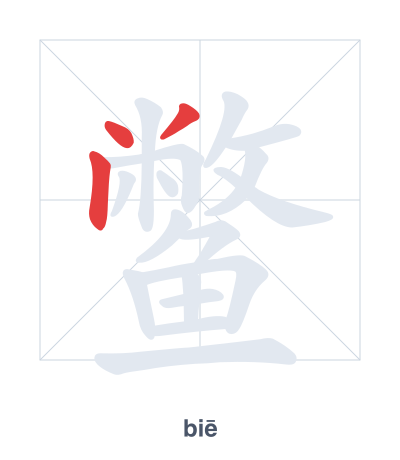
Open Hanzi Writer to see the animated stroke order and practice writing 鳖 with real-time feedback.
The character 鳖 (biē) is written with 19 strokes. Follow the standard Chinese stroke order: top to bottom, left to right, outside before inside. The radical 鱼 is one of its key components.
Practice the correct stroke order with the Hanzi Writer app to see animated stroke-by-stroke guidance with real-time feedback.
鳖 means soft-shelled turtle.
鳖 combines the radical 鱼 (fish), indicating its aquatic nature, with the component 敝 (shabby, worn out), which hints at the soft, broken-looking shell of the soft-shelled turtle.
💡 Memory Tip: Picture a shabby (敝) fish (鱼) that crawled onto land and became a turtle with a soft, tattered shell.
甲鳖通常躲在泥沙里。
jiǎ biē tōng cháng duǒ zài ní shā lǐ
Soft-shell turtles usually hide in the mud and sand.
鳖汤被认为非常有营养。
biē tāng bèi rèn wéi fēi cháng yǒu yíng yǎng
Soft-shelled turtle soup is considered very nutritious.
我们要来个瓮中捉鳖。
wǒ men yào lái gè wèng zhōng zhuō biē
We're going to catch them like a rat in a hole.
Open Hanzi Writer to see the animated stroke order and practice writing 鳖 with real-time feedback.
✨ Animated stroke order · Handwriting recognition · HSK-graded practice · Free to use
鳖 combines the radical 鱼 (fish) on top, with 敝 (shabby/destroy) below. The fish radical indicates it is an aquatic animal, while 敝 hints at its flat, seemingly "broken" shell shape.