萆 (bì) means "castor oil plant (used in plant names)" in Chinese. It has 11 strokes with the radical 艹.
Rated 4.2/5 in difficulty (advanced).
Appears in 3+ common words including 萆薢 (bì xiè), 萆薢粥 (bì xiè zhōu), 萆薢汤 (bì xiè tāng).
Due to its 11 strokes, Hanzi Writer's error detection shows 萆 requires focused practice — most learners need 10+ attempts for consistent accuracy.
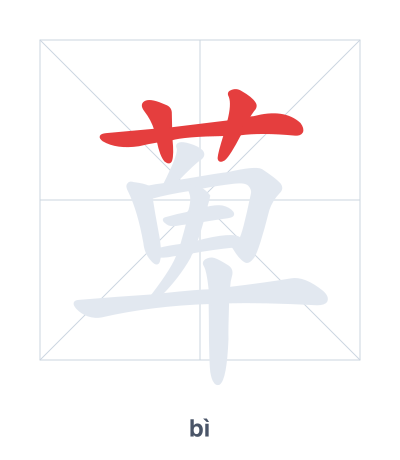
Open Hanzi Writer to see the animated stroke order and practice writing 萆 with real-time feedback.
The character 萆 (bì) is written with 11 strokes. Follow the standard Chinese stroke order: top to bottom, left to right, outside before inside. The radical 艹 is one of its key components.
Practice the correct stroke order with the Hanzi Writer app to see animated stroke-by-stroke guidance with real-time feedback.
萆 means castor oil plant (used in plant names).
萆 is a phono-semantic compound: the radical 艹 (grass) indicates it's a plant, while 卑 (bēi, meaning low or humble) provides the pronunciation and hints at the plant's low-growing or unassuming nature. The castor oil plant (Ricinus communis) is a tall shrub, so the 'low' component may refer to its weedy habit or the ground-level oil extraction process.
💡 Memory Tip: Imagine a low (卑) grass (艹) patch where a castor bean is growing, but when you pick it, the stem oozes bitter oil—so you wipe it off with a rag, muttering 'bì' (bitter).
萆薢是一种中药。
bì xiè shì yī zhǒng zhōng yào
Bixie is a type of traditional Chinese medicine.
他每天喝萆薢粥。
tā měi tiān hē bì xiè zhōu
He drinks Bixie (herbal) porridge every day.
医生开了萆薢汤。
yī shēng kāi le bì xiè tāng
The doctor prescribed Bixie decoction.
Open Hanzi Writer to see the animated stroke order and practice writing 萆 with real-time feedback.
✨ Animated stroke order · Handwriting recognition · HSK-graded practice · Free to use
萆 is composed of the grass radical 艹 on top and the phonetic component 卑 (bēi) below. The 艹 indicates it is a plant, while 卑 provides the approximate pronunciation bì. Together, it forms a phono-semantic compound used in plant names.