埄 (běng) means "dust" in Chinese. It has 10 strokes with the radical 土.
Rated 4.2/5 in difficulty (advanced).
Appears in 3+ common words including 埄尘 (běng chén), 埄堗 (běng tū), 埄埄 (běng běng).
Due to its 10 strokes, Hanzi Writer's error detection shows 埄 requires focused practice — most learners need 10+ attempts for consistent accuracy.
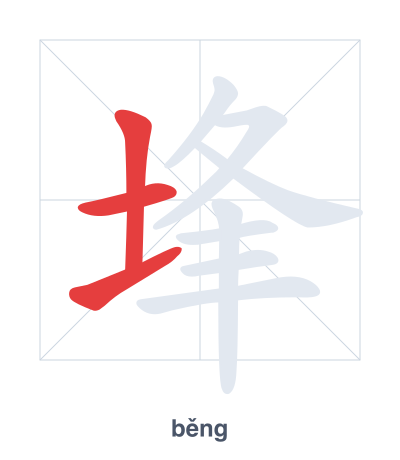
Open Hanzi Writer to see the animated stroke order and practice writing 埄 with real-time feedback.
The character 埄 (běng) is written with 10 strokes. Follow the standard Chinese stroke order: top to bottom, left to right, outside before inside. The radical 土 is one of its key components.
Practice the correct stroke order with the Hanzi Writer app to see animated stroke-by-stroke guidance with real-time feedback.
埄 means dust.
埄 is a compound character with the radical 土 (earth) indicating dirt or dust, and the component 夆 (fēng) which may phonetically hint at the sound of dust rising or suggest a stirring motion. Together, the character visually represents earth particles being disturbed or floating in the air, hence the meaning 'dust'.
💡 Memory Tip: Imagine a big 'bang' (běng) on the ground (土) that kicks up dust in a shape like a leg (夂) kicking a fluffy cloud (丰).
屋里落满了埄尘。
wū lǐ luò mǎn le běng chén
The room is covered in dust.
埄堗随风飘散。
běng tū suí fēng piāo sàn
The rising dust scatters with the wind.
这里的埄埄很多。
zhè lǐ de běng běng hěn duō
There are many dust clouds here.
Open Hanzi Writer to see the animated stroke order and practice writing 埄 with real-time feedback.
✨ Animated stroke order · Handwriting recognition · HSK-graded practice · Free to use
埄 combines the radical 土 (earth, soil) on the left with 奉 (fèng, meaning 'to offer') on the right. Since dust is fine earth particles, the earth radical directly connects to the meaning, while 奉 may suggest the idea of dust being 'offered up' into the air. This structure makes 埄 a semantic-phonetic compound, though the pronunciation (běng) differs from 奉.