畚 (běn) means "Dustpan or basket" in Chinese. It has 10 strokes with the radical 田.
Rated 4.2/5 in difficulty (advanced).
Appears in 3+ common words including 畚箕 (běn jī), 畚斗 (běn dǒu), 畚 (běn).
Due to its 10 strokes, Hanzi Writer's error detection shows 畚 requires focused practice — most learners need 10+ attempts for consistent accuracy.
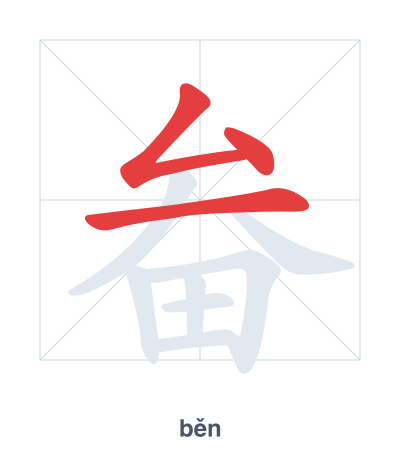
Open Hanzi Writer to see the animated stroke order and practice writing 畚 with real-time feedback.
The character 畚 (běn) is written with 10 strokes. Follow the standard Chinese stroke order: top to bottom, left to right, outside before inside. The radical 田 is one of its key components.
Practice the correct stroke order with the Hanzi Writer app to see animated stroke-by-stroke guidance with real-time feedback.
畚 means Dustpan or basket.
The character 畚 is a compound where the top part 田 originally depicted a woven basket or container, and the bottom 廾 represents two hands holding it. Together, they illustrate a dustpan or basket grasped by hands, used for carrying dirt or grain in farming contexts.
💡 Memory Tip: Picture a square basket (田) with two handles (廾) below, and imagine yourself gripping those handles to scoop up a pile of dirt.
请用畚箕把垃圾倒掉。
qǐng yòng běn jī bǎ lā jī dào diào
Please use the dustpan to throw away the trash.
畚斗放在门后面了。
běn dǒu fàng zài mén hòu miàn le
The dustpan was put behind the door.
这个工具在农场很常见。
zhè ge gōng jù zài nóng chǎng hěn cháng jiàn
This tool is very common on farms.
Open Hanzi Writer to see the animated stroke order and practice writing 畚 with real-time feedback.
✨ Animated stroke order · Handwriting recognition · HSK-graded practice · Free to use
畚 is made of two parts: the top 大 (big) and the bottom 田 (field). The character represents a large container traditionally used in fields for carrying dirt or harvested crops, connecting "big" and "field" to form the idea of a dustpan or basket.