褒 (bāo) means "to praise; to commend; large (garment)" in Chinese. It has 15 strokes with the radical 衣.
Rated 4.2/5 in difficulty (advanced).
Appears in 3+ common words including 褒奖 (bāo jiǎng), 褒义词 (bāo yì cí), 褒贬 (bāo biǎn).
Due to its 15 strokes, Hanzi Writer's error detection shows 褒 requires focused practice — most learners need 10+ attempts for consistent accuracy.
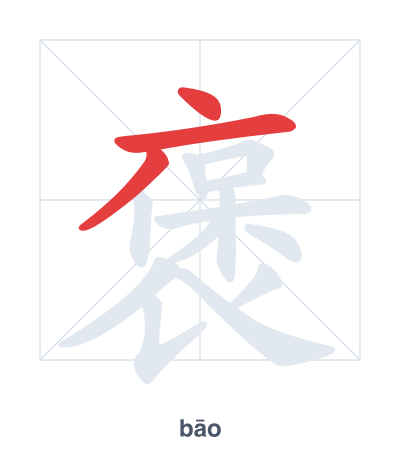
Open Hanzi Writer to see the animated stroke order and practice writing 褒 with real-time feedback.
The character 褒 (bāo) is written with 15 strokes. Follow the standard Chinese stroke order: top to bottom, left to right, outside before inside. The radical 衣 is one of its key components.
Practice the correct stroke order with the Hanzi Writer app to see animated stroke-by-stroke guidance with real-time feedback.
褒 means to praise; to commend; large (garment).
| Character | 褒 |
| Pinyin | bāo (bao) |
| Meaning | to praise; to commend; large (garment) |
| Strokes | 15 |
| Radical | 衣 |
| Difficulty | 4.2/5 |
褒 is a phono-semantic compound combining 衣 (clothing), indicating its original meaning as a large garment, with 保 (bǎo) as a phonetic component. The meaning extended from a grand robe to the act of praising someone, as such garments were awarded as honors.
💡 Memory Tip: Picture a huge robe (衣) that you wrap around someone while saying 'I praise (褒) you' — the top part 保 (protect) reminds you that this praise protects their reputation.
他得到了学校的褒奖。
tā dé dào le xué xiào de bāo jiǎng
He received an award from the school.
“勇敢”是一个褒义词。
yǒng gǎn shì yí gè bāo yì cí
'Brave' is a word with positive connotations.
大家对他褒贬不一。
dà jiā duì tā bāo biǎn bù yī
Everyone has mixed reviews about him.
Open Hanzi Writer to see the animated stroke order and practice writing 褒 with real-time feedback.
✨ Animated stroke order · Handwriting recognition · HSK-graded practice · Free to use
褒 is composed of 保 (bǎo, to protect) on top and 衣 (yī, clothing) below. Together, they suggest a large garment that protects the body, which connects to the original meaning of "large garment." Over time, the meaning shifted to "to praise," because giving someone a fine robe was a way to honor them.