捌 (bā) means "eight (formal)" in Chinese. It has 10 strokes with the radical 扌.
Rated 4.2/5 in difficulty (advanced).
Appears in 3+ common words including 捌万 (bā wàn), 捌圆 (bā yuán), 捌月 (bā yuè).
Due to its 10 strokes, Hanzi Writer's error detection shows 捌 requires focused practice — most learners need 10+ attempts for consistent accuracy.
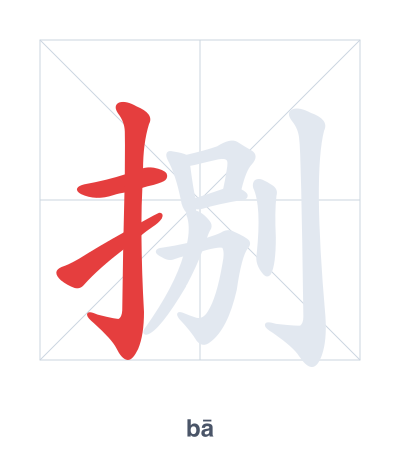
Open Hanzi Writer to see the animated stroke order and practice writing 捌 with real-time feedback.
The character 捌 (bā) is written with 10 strokes. Follow the standard Chinese stroke order: top to bottom, left to right, outside before inside. The radical 扌 is one of its key components.
Practice the correct stroke order with the Hanzi Writer app to see animated stroke-by-stroke guidance with real-time feedback.
捌 means eight (formal).
The left side 扌 (hand) and right side 别 (separate) originally depicted breaking or splitting something apart with the hands. This meaning was later borrowed phonetically to represent the number eight in formal financial contexts, preventing forgery of the simpler character 八.
💡 Memory Tip: Picture your hand (扌) using a knife (刂) to slice a figure-eight-shaped cake into two separate (别) halves.
支票上写着捌万元整。
zhī piào shàng xiě zhe bā wàn yuán zhěng
The check says exactly eighty thousand yuan.
这件衣服捌拾圆。
zhè jiàn yī fú bā shí yuán
This piece of clothing is eighty yuan.
捌月是炎热的季节。
bā yuè shì yán rè de jì jié
August is a hot season.
Open Hanzi Writer to see the animated stroke order and practice writing 捌 with real-time feedback.
✨ Animated stroke order · Handwriting recognition · HSK-graded practice · Free to use
捌 is made of two parts: the left side is the radical 扌 (hand), and the right side is 别 (bié), which means 'separate' or 'other'. The hand radical hints at an original meaning of 'to break apart,' but today 捌 is used as the formal character for the number eight.