铵 (ǎn) means "Ammonium" in Chinese. It has 11 strokes with the radical 钅.
Rated 4.2/5 in difficulty (advanced).
Appears in 3+ common words including 铵盐 (ǎn yán), 硫酸铵 (liú suān ǎn), 氯化铵 (lǜ huà ǎn).
Due to its 11 strokes, Hanzi Writer's error detection shows 铵 requires focused practice — most learners need 10+ attempts for consistent accuracy.
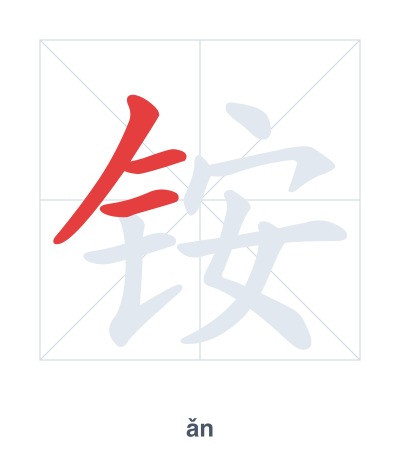
Open Hanzi Writer to see the animated stroke order and practice writing 铵 with real-time feedback.
The character 铵 (ǎn) is written with 11 strokes. Follow the standard Chinese stroke order: top to bottom, left to right, outside before inside. The radical 钅 is one of its key components.
Practice the correct stroke order with the Hanzi Writer app to see animated stroke-by-stroke guidance with real-time feedback.
铵 means Ammonium.
铵 is a compound character. The left component 钅 (metal radical) indicates it's a chemical element or ion, while the right component 安 (ān, meaning peace) provides the pronunciation. It was coined in modern chemistry to represent ammonium (NH₄⁺), a positively charged ion that behaves somewhat like a metal in compounds.
💡 Memory Tip: Picture a peaceful (安) piece of metal (钅) gently floating in a lab flask—that's stable ammonium.
铵盐易溶于水。
ǎn yán yì róng yú shuǐ
Ammonium salts are easily soluble in water.
硫酸铵是化肥。
liú suān ǎn shì huà féi
Ammonium sulfate is a chemical fertilizer.
氯化铵有药用价值。
lǜ huà ǎn yǒu yào yòng jià zhí
Ammonium chloride has medicinal value.
Open Hanzi Writer to see the animated stroke order and practice writing 铵 with real-time feedback.
✨ Animated stroke order · Handwriting recognition · HSK-graded practice · Free to use
The character 铵 (ǎn) is composed of two parts: the radical 钅 (jīn, meaning 'metal' or 'gold') on the left, and the phonetic component 安 (ān, meaning 'peace' or 'safe') on the right. The radical indicates that 铵 is a chemical element related to metals or minerals, while 安 provides a clue to its pronunciation (ǎn). Together, they form the character for 'ammonium', a positively charged ion found in chemical compounds.