橥 (zhū) means "stake; post" in Chinese. It has 15 strokes with the radical 木.
Rated 4.2/5 in difficulty (advanced).
Appears in 3+ common words including 橥橛 (zhū jué), 橥杙 (zhū yì), 橥桩 (zhū zhuāng).
Due to its 15 strokes, Hanzi Writer's error detection shows 橥 requires focused practice — most learners need 10+ attempts for consistent accuracy.
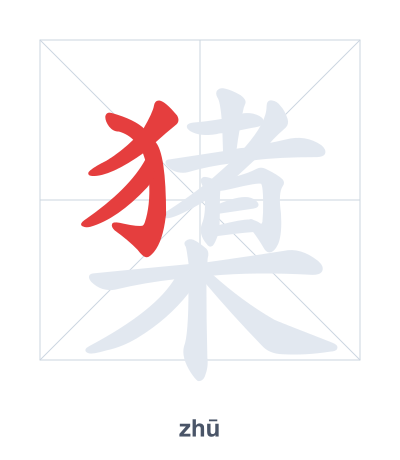
Open Hanzi Writer to see the animated stroke order and practice writing 橥 with real-time feedback.
The character 橥 (zhū) is written with 15 strokes. Follow the standard Chinese stroke order: top to bottom, left to right, outside before inside. The radical 木 is one of its key components.
Practice the correct stroke order with the Hanzi Writer app to see animated stroke-by-stroke guidance with real-time feedback.
橥 means stake; post.
This character combines the radical 木 (wood) with 猪 (pig), which provides the pronunciation zhū and hints at a wooden stake used to tether pigs. The visual structure thus directly depicts a post (木) associated with a pig (猪).
💡 Memory Tip: Picture a wooden post (木) with a pig (猪) tied to it—that stake is your 橥.
橥橛钉在地上。
zhū jué dīng zài dì shàng
The stake is driven into the ground.
这是一个橥杙。
zhè shì yí gè zhū yì
This is a wooden stake.
橥桩很稳固。
zhū zhuāng hěn wěn gù
The stake is very stable.
Open Hanzi Writer to see the animated stroke order and practice writing 橥 with real-time feedback.
✨ Animated stroke order · Handwriting recognition · HSK-graded practice · Free to use
橥 is made of the radical 木 (wood) on the left and the character 猪 (pig) on the right. The 木 radical shows that 橥 relates to wood, and its meaning "stake; post" comes from a wooden object. The right side 猪 provides the pronunciation zhū.