椥 (zhī) means "Nagi (a type of tree)" in Chinese. It has 12 strokes with the radical 木.
Rated 4.2/5 in difficulty (advanced).
Appears in 3+ common words including 椥辻 (zhī shí), 椥木 (zhī mù), 椥辻站 (zhī shí zhàn).
Due to its 12 strokes, Hanzi Writer's error detection shows 椥 requires focused practice — most learners need 10+ attempts for consistent accuracy.
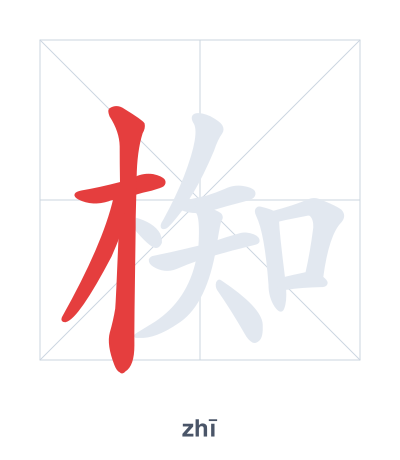
Open Hanzi Writer to see the animated stroke order and practice writing 椥 with real-time feedback.
The character 椥 (zhī) is written with 12 strokes. Follow the standard Chinese stroke order: top to bottom, left to right, outside before inside. The radical 木 is one of its key components.
Practice the correct stroke order with the Hanzi Writer app to see animated stroke-by-stroke guidance with real-time feedback.
椥 means Nagi (a type of tree).
椥 combines the radical 木 (tree) with the phonetic component 知 (zhī, 'to know'), indicating a tree known for its distinctive characteristics, specifically the Nagi tree native to East Asia.
💡 Memory Tip: Picture a wise old Nagi tree (木) with a mouth (口) and an arrow (矢) pointing to its leaves, as if it knows all the secrets of the forest.
椥辻是一个地名。
zhī shí shì yí gè dì míng
Nagitsuji is a place name.
这种树被称作椥木。
zhè zhòng shù bèi chēng zuò zhī mù
This tree is called Zhi wood.
他在椥辻站下车。
tā zài zhī shí zhàn xià chē
He got off at Nagitsuji Station.
Open Hanzi Writer to see the animated stroke order and practice writing 椥 with real-time feedback.
✨ Animated stroke order · Handwriting recognition · HSK-graded practice · Free to use
椥 is made of two parts: the left radical 木 (tree) and the right component 知 (to know). The 木 indicates that this character refers to a type of tree, while 知 provides the pronunciation zhī. Together, they form the name of the Nagi tree, a species in the Podocarpus family.