Hanzi Writer

How to Write 樟 (zhāng) — Meaning “camphor tree”

zhāng 15 strokes Radical: 木

樟 (zhāng) means "camphor tree" in Chinese. It has 15 strokes with the radical 木.

Rated 4.2/5 in difficulty (advanced).

Appears in 3+ common words including 樟树 (zhāng shù), 樟脑 (zhāng nǎo), 樟木 (zhāng mù).

Due to its 15 strokes, Hanzi Writer's error detection shows 樟 requires focused practice — most learners need 10+ attempts for consistent accuracy.
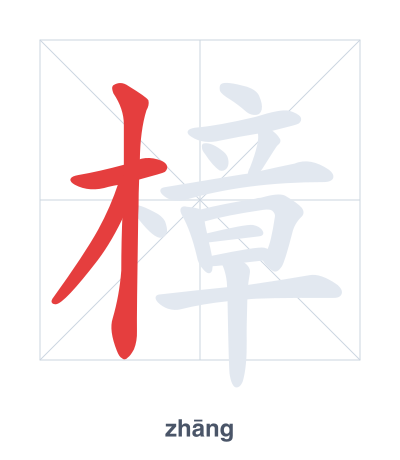
Stroke order practice for 樟 - zhāng

Practice Writing 樟 (zhāng)

Open Hanzi Writer to see the animated stroke order and practice writing 樟 with real-time feedback.

The character (zhāng) is written with 15 strokes. Follow the standard Chinese stroke order: top to bottom, left to right, outside before inside. The radical is one of its key components.

Practice the correct stroke order with the Hanzi Writer app to see animated stroke-by-stroke guidance with real-time feedback.

means camphor tree.

Character
Pinyinzhāng (zhang)
Meaningcamphor tree
Strokes15
Radical
Difficulty4.2/5

樟 is a phono-semantic compound: the radical 木 (tree) indicates it's a type of tree, while 章 provides the pronunciation zhāng and originally means 'chapter' or 'pattern,' possibly hinting at the camphor tree's striped bark or layered fragrance.

💡 Memory Tip: Picture a camphor tree (木) with a chapter (章) of its aromatic story carved into the trunk.

zhāng shù
camphor tree
zhāng nǎo
camphor
zhāng mù
camphor wood

路边有很多樟树。

lù biān yǒu hěn duō zhāng shù

There are many camphor trees by the roadside.

柜子里放了樟脑。

guì zi lǐ fàng le zhāng nǎo

There is camphor in the cabinet.

这个箱子是樟木做的。

zhè ge xiāng zi shì zhāng mù zuò de

This box is made of camphor wood.

Character Pinyin Strokes Radical
(current) zhāng 15
duàn 13
shèn 13
chuán 13
Stroke order practice for 樟 - zhāng

Practice Writing 樟 (zhāng)

Open Hanzi Writer to see the animated stroke order and practice writing 樟 with real-time feedback.

✨ Animated stroke order · Handwriting recognition · HSK-graded practice · Free to use

Frequently Asked Questions about 樟

樟 is made of the radical 木 (tree) on the left and the phonetic component 章 (zhāng) on the right. The radical tells you it is a type of tree, while 章 provides the pronunciation and hints at the tree's use in making seals or its layered bark.

Characters with Radical 木

Other 15-Stroke Characters