昃 (zè) means "The sun declining to the west; afternoon." in Chinese. It has 8 strokes with the radical 日.
Rated 3.7/5 in difficulty (challenging).
Appears in 3+ common words including 日昃 (rì zè), 昃食 (zè shí), 昃影 (zè yǐng).
Due to its 8 strokes, Hanzi Writer's error detection shows 昃 requires focused practice — most learners need 10+ attempts for consistent accuracy.
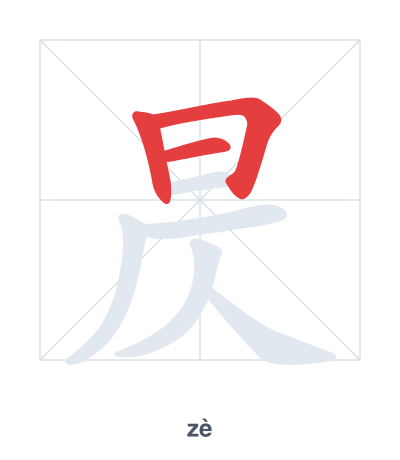
Open Hanzi Writer to see the animated stroke order and practice writing 昃 with real-time feedback.
The character 昃 (zè) is written with 8 strokes. Follow the standard Chinese stroke order: top to bottom, left to right, outside before inside. The radical 日 is one of its key components.
Practice the correct stroke order with the Hanzi Writer app to see animated stroke-by-stroke guidance with real-time feedback.
昃 means The sun declining to the west; afternoon..
昃 combines the sun radical 日 with 仄 (slanting), where 仄 shows a person leaning against a cliff, symbolizing the sun tilting downward. This depicts the sun declining westward, marking the afternoon hours.
💡 Memory Tip: The sun (日) takes a lazy afternoon lean (仄), just like someone slouching against a wall after lunch.
此时已经日昃。
cǐ shí yǐ jīng rì zè
It is already late afternoon.
昃食宵衣很忙碌。
zè shí xiāo yī hěn máng lù
Working from dawn to dusk is very busy.
昃影斜斜。
zè yǐng xié xié
The afternoon shadows are slanted.
Open Hanzi Writer to see the animated stroke order and practice writing 昃 with real-time feedback.
✨ Animated stroke order · Handwriting recognition · HSK-graded practice · Free to use
昃 is composed of the radical 日 (sun) on top and 仄 (slanting) below. The sun (日) combined with the idea of slanting (仄) evokes the image of the sun tilting downward in the sky. This directly represents the meaning of the sun declining to the west or afternoon.