Hanzi Writer

How to Write 芋 (yù) — Meaning “Taro”

6 strokes Radical: 艹

芋 (yù) means "Taro" in Chinese. It has 6 strokes with the radical 艹.

Rated 3.2/5 in difficulty (challenging).

Appears in 3+ common words including 芋头 (yù tou), 芋圆 (yù yuán), 香芋 (xiāng yù).

Due to its 6 strokes, Hanzi Writer's error detection shows 芋 requires focused practice — most learners need 10+ attempts for consistent accuracy.
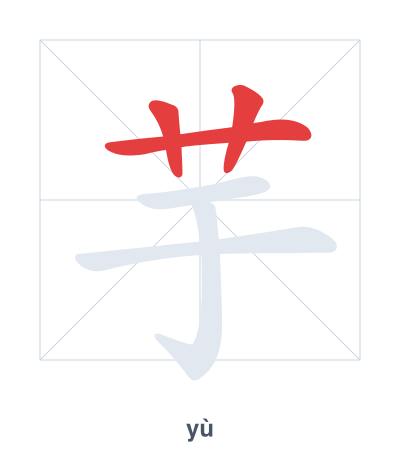
Stroke order practice for 芋 - yù

Practice Writing 芋 (yù)

Open Hanzi Writer to see the animated stroke order and practice writing 芋 with real-time feedback.

The character (yù) is written with 6 strokes. Follow the standard Chinese stroke order: top to bottom, left to right, outside before inside. The radical is one of its key components.

Practice the correct stroke order with the Hanzi Writer app to see animated stroke-by-stroke guidance with real-time feedback.

means Taro.

Character
Pinyinyù (yu)
MeaningTaro
Strokes6
Radical
Difficulty3.2/5

芋 combines the plant radical 艹 (grass) with 于 (yú), which serves as a phonetic component indicating the pronunciation. The character depicts a leafy plant whose edible underground stem is taro.

💡 Memory Tip: Picture grass (艹) sprouting from a large taro root shaped like the hook of the character 于.

yù tou
Taro
yù yuán
Taro balls
xiāng yù
taro

我喜欢吃芋头。

wǒ xǐ huān chī yù tou

I like eating taro.

这个芋圆很好吃。

zhè ge yù yuán hěn hǎo chī

These taro balls are delicious.

香芋冰淇淋很甜。

xiāng yù bīng qí lín hěn tián

Taro ice cream is very sweet.

Character Pinyin Strokes Radical
(current) 6
4
6
jiāo 5
Stroke order practice for 芋 - yù

Practice Writing 芋 (yù)

Open Hanzi Writer to see the animated stroke order and practice writing 芋 with real-time feedback.

✨ Animated stroke order · Handwriting recognition · HSK-graded practice · Free to use

Frequently Asked Questions about 芋

The character 芋 is composed of the radical 艹 (grass or plant) on top and the phonetic component 于 (yú) below. The 艹 radical indicates that 芋 is a type of plant, specifically the taro plant. The lower part 于 does not directly add to the meaning but gives a clue to the pronunciation, which is close to yú.

Characters with Radical 艹

Other 6-Stroke Characters