妪 (yù) means "old woman" in Chinese. It has 7 strokes with the radical 女.
Rated 3.5/5 in difficulty (challenging).
Appears in 3+ common words including 老妪 (lǎo yù), 农妪 (nóng yù), 妪媪 (yù ǎo).
Due to its 7 strokes, Hanzi Writer's error detection shows 妪 requires focused practice — most learners need 10+ attempts for consistent accuracy.
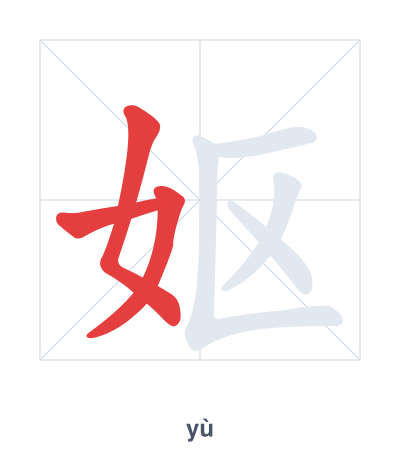
Open Hanzi Writer to see the animated stroke order and practice writing 妪 with real-time feedback.
The character 妪 (yù) is written with 7 strokes. Follow the standard Chinese stroke order: top to bottom, left to right, outside before inside. The radical 女 is one of its key components.
Practice the correct stroke order with the Hanzi Writer app to see animated stroke-by-stroke guidance with real-time feedback.
妪 means old woman.
妪 combines the radical 女 (woman) with 区 (area/region). Historically, 区 may have contributed a phonetic hint (though pronunciation shifted) and also a semantic nuance of 'bent'—as seen in 伛 (stooped)—suggesting an elderly woman's bent posture.
💡 Memory Tip: Imagine an old woman (女) with a walking stick that looks like the box-and-cross shape of 区, hunched over as she shuffles along.
那位老妪在树下休息。
nà wèi lǎo yù zài shù xià xiū xī
That old woman is resting under the tree.
农妪正在田里干活。
nóng yù zhèng zài tián lǐ gàn huó
The old farm woman is working in the field.
邻居是一位善良的老妪。
lín jū shì yī wèi shàn liáng de lǎo yù
The neighbor is a kind old woman.
Open Hanzi Writer to see the animated stroke order and practice writing 妪 with real-time feedback.
✨ Animated stroke order · Handwriting recognition · HSK-graded practice · Free to use
The character 妪 is composed of the radical 女 (nǚ, woman) on the left, which indicates that the meaning relates to a female person. The right side is 区 (qū), which provides a phonetic clue to the pronunciation "yù." Together, they form a character that means "old woman."