Hanzi Writer

How to Write 吲 (yǐn) — Meaning “smile (archaic); used in chemical terms”

yǐn 7 strokes Radical: 口

吲 (yǐn) means "smile (archaic); used in chemical terms" in Chinese. It has 7 strokes with the radical 口.

Rated 3.5/5 in difficulty (challenging).

Appears in 3+ common words including 吲哚 (yǐn duǒ), 吲哚类 (yǐn duǒ lèi), 吲哚环 (yǐn duǒ huán).

Due to its 7 strokes, Hanzi Writer's error detection shows 吲 requires focused practice — most learners need 10+ attempts for consistent accuracy.
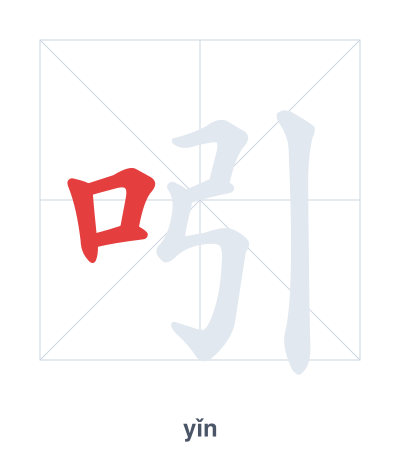
Stroke order practice for 吲 - yǐn

Practice Writing 吲 (yǐn)

Open Hanzi Writer to see the animated stroke order and practice writing 吲 with real-time feedback.

The character (yǐn) is written with 7 strokes. Follow the standard Chinese stroke order: top to bottom, left to right, outside before inside. The radical is one of its key components.

Practice the correct stroke order with the Hanzi Writer app to see animated stroke-by-stroke guidance with real-time feedback.

means smile (archaic); used in chemical terms.

Character
Pinyinyǐn (yin)
Meaningsmile (archaic); used in chemical terms
Strokes7
Radical
Difficulty3.5/5

A phono-semantic compound: the mouth radical (口) indicates the facial expression, while the right component 尹 (yǐn) provides the pronunciation. Originally used to denote a smile, it is now primarily found in chemical terminology such as 吲哚 (indole).

💡 Memory Tip: Picture a mouth (口) smiling widely, with the right side 尹 resembling a happy eyebrow and a curved cheek.

yǐn duǒ
indole
yǐn duǒ lèi
indoles
yǐn duǒ huán
indole ring

这种物质叫吲哚。

zhè zhǒng wù zhì jiào yǐn duǒ

This substance is called indole.

这是吲哚类化合物。

zhè shì yǐn duǒ lèi huà hé wù

This is an indole compound.

它含有吲哚环结构。

tā hán yǒu yǐn duǒ huán jié gòu

It contains an indole ring structure.

Character Pinyin Strokes Radical
(current) yǐn 7
5
5
gōu / jù 5
Stroke order practice for 吲 - yǐn

Practice Writing 吲 (yǐn)

Open Hanzi Writer to see the animated stroke order and practice writing 吲 with real-time feedback.

✨ Animated stroke order · Handwriting recognition · HSK-graded practice · Free to use

Frequently Asked Questions about 吲

吲 is composed of the left radical 口 (mouth) and the right component 引 (yǐn, to pull). The mouth radical hints at the character's archaic meaning 'smile,' while 引 provides the pronunciation yǐn. Together, the shape suggests a mouth being pulled into a smile.

Characters with Radical 口

Other 7-Stroke Characters