鮨 (yì) means "Sushi / Grouper" in Chinese. It has 17 strokes with the radical 魚.
Rated 3.8/5 in difficulty (challenging).
Appears in 3+ common words including 鮨店 (yì diàn), 鮨鱼 (yì yú), 寿司鮨 (shòu sī yì).
Due to its 17 strokes, Hanzi Writer's error detection shows 鮨 requires focused practice — most learners need 10+ attempts for consistent accuracy.
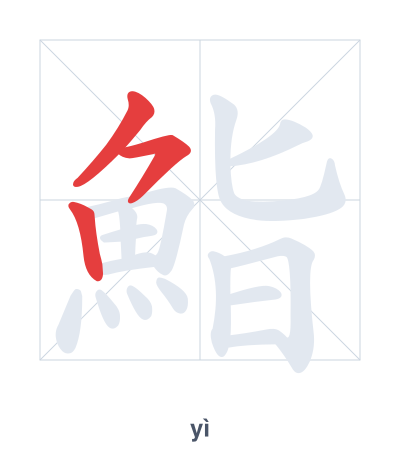
Open Hanzi Writer to see the animated stroke order and practice writing 鮨 with real-time feedback.
The character 鮨 (yì) is written with 17 strokes. Follow the standard Chinese stroke order: top to bottom, left to right, outside before inside. The radical 魚 is one of its key components.
Practice the correct stroke order with the Hanzi Writer app to see animated stroke-by-stroke guidance with real-time feedback.
鮨 means Sushi / Grouper.
| Character | 鮨 |
| Pinyin | yì (yi) |
| Meaning | Sushi / Grouper |
| Strokes | 17 |
| Radical | 魚 |
| Difficulty | 3.8/5 |
鮨 combines the radical 魚 (fish) with 旨 (zhǐ, meaning 'tasty' or 'delicious'). The right component 旨 originally depicted a spoon (匕) over a mouth or sun (日), conveying the sense of fine flavor—so 鮨 literally suggests a fish that is especially flavorful, hence sushi or grouper.
💡 Memory Tip: Picture a grouper fish wearing a chef's hat and holding a spoon (匕) up to the sun (日), proudly proving its taste is top-notch.
我们去那家鮨店吧。
wǒ men qù nà jiā yì diàn ba
Let's go to that sushi restaurant.
这种鱼叫作鮨鱼。
zhè zhǒng yú jiào zuò yì yú
This kind of fish is called a grouper.
寿司鮨很受欢迎。
shòu sī yì hěn shòu huān yíng
Sushi is very popular.
Open Hanzi Writer to see the animated stroke order and practice writing 鮨 with real-time feedback.
✨ Animated stroke order · Handwriting recognition · HSK-graded practice · Free to use
The character 鮨 is composed of two parts: the left radical 魚 (fish) and the right component 旨 (meaning 'tasty' or 'delicious'). Together, they suggest a fish that is tasty or prepared in a delicious way, which relates to sushi (a dish made with fresh fish) or grouper (a type of tasty fish). The radical 魚 gives the general category of 'fish', while 旨 adds the idea of flavor.